Being Good at Your Job Won’t Save You From Corporate Politics
One of the biggest corporate lessons people learn the hard way is this:
Being good at your job does not always protect you.
It does not always protect you from layoffs.
It does not always protect you from office politics.
It does not always protect you from leadership changes.
It does not always protect you from budget decisions.
And it definitely does not protect you from conversations happening behind closed doors.
After working in HR for over 10 years and experiencing a layoff myself, I need more employees to understand that performance is important, but performance is not always the full story.
Sometimes you can be great at your job and still get caught in something that has nothing to do with how well you performed.
That is the part people do not always want to say out loud.
But we’re saying it today.
Your job is not your safety net
One thing about me?
I never fully decorated my office at any job.
Not because I did not care.
Not because I was not committed.
Not because I was planning to leave every five business days.
But because after working in HR for years, I understood something a lot of employees do not learn until it hurts:
The office belongs to the company.
The title belongs to the company.
The email belongs to the company.
The laptop belongs to the company.
The access badge belongs to the company.
Even the “we’re like family” speeches belong to the company.
But your career?
That has to belong to you.
That does not mean you should work scared. It means you should work aware.
There is a difference.
Working scared means you are operating from panic.
Working aware means you understand the reality of corporate life and you prepare accordingly.
Because corporate will let you believe everything is fine right up until your login stops working.
Performance is not always the full story
A lot of employees think their performance review tells the full story of their job security.
It does not.
Your performance review may tell you how your work is being documented, but it does not always tell you what is being said in rooms you are not invited into.
Behind the scenes, there may be conversations about:
Budgets
Restructuring
Leadership changes
Department value
Salaries
Influence
Personalities
Team alignment
Who leadership wants around
Who leadership does not want around anymore
And sometimes, none of that has anything to do with whether you are good at your job.
A layoff is not always about poor performance.
Sometimes it is about money.
Sometimes it is about control.
Sometimes it is about politics.
Sometimes a new leader comes in and wants their own people.
Sometimes you ask too many questions.
Sometimes you have too much influence.
Sometimes your salary is expensive.
And sometimes?
You are simply no longer convenient.
That is why doing good work matters, but it cannot be your only safety net.
Signs your role may be vulnerable
I do not believe in fearmongering, but I do believe in paying attention.
Here are a few signs that your role, reputation, or position at work may be more vulnerable than you think.
1. You start getting left out of conversations you used to be included in
One missed meeting may mean nothing.
But if decisions are being made without you, people are “forgetting” to invite you, or your input is no longer being requested, pay attention.
A pattern is information.
Being excluded from conversations can sometimes mean your role is being minimized, your influence is being reduced, or decisions are happening without your involvement.
It may not mean you are being pushed out immediately, but it is something to watch.
2. Your work starts being questioned more than usual
If your work starts getting extra scrutiny, even though the quality has not changed, pay attention.
Suddenly, everything needs extra review.
Suddenly, your decisions need to be explained three different ways.
Suddenly, things that were fine before are a problem.
That can be a sign that someone is building a narrative.
And in corporate, narratives matter.
3. Documentation shifts from coaching to collecting evidence
Documentation is not always bad.
In fact, proper documentation can protect employees and employers when used correctly.
But there is a difference between coaching someone and collecting evidence.
If every conversation starts feeling like it could become a screenshot later, pay attention.
If small things that were ignored before are suddenly being written down, documented, or escalated, that shift may be telling you something.
4. Your responsibilities start changing without explanation
Another sign to watch for is when your responsibilities start shifting without a clear explanation.
Important projects may be moved away from you.
Someone else may suddenly be looped into your work.
Your role may start shrinking, but nobody says anything directly.
That does not automatically mean something bad is happening, but it may be a sign that decisions are being made behind the scenes.
5. A new leader comes in and starts bringing in their own people
When leadership changes, the power map changes.
Sometimes it does not matter how good you were under the previous leader.
A new leader may want their own team, their own structure, their own loyalists, and their own people who already know how they like to work.
That does not automatically mean you are being pushed out.
But it does mean you need to watch the room.
Build a “They Might Switch Up” folder
So what do you do with all of this?
You prepare.
Not panic.
Prepare.
Every employee should have what I call a “They Might Switch Up” folder.
Because they might.
And honestly, at some point, they probably will.
This folder should have what you would need if you had to start applying for jobs tomorrow.
Not six months from now.
Tomorrow.
1. Keep your resume updated
Do not wait until you are frustrated, panicking, unemployed, or emotionally drained to update your resume.
Keep it current.
Your resume should include your current role, strongest accomplishments, and numbers wherever possible.
Do not rely on memory.
When you are in crisis mode, you will forget half the things you did.
2. Keep a brag sheet
A brag sheet is where you track your wins.
Projects you completed
Processes you improved
Money you saved
Systems you implemented
People you trained
Problems you solved
Awards or recognition
Positive feedback
Keep this updated while you are calm.
Because when you are applying for jobs, interviewing, or trying to explain your value, you do not want to start from scratch.
3. Keep proof of your work where appropriate
Let me be clear.
Do not take confidential company information.
We are not doing jailhouse LinkedIn.
But you can keep professional records of your accomplishments.
That may include:
Performance reviews
Praise from leadership
Training certificates
Public projects
Metrics you are allowed to reference
Non-confidential examples of your work
Keep your receipts, but keep them appropriate.
4. Keep your network warm
I know networking can feel fake, awkward, and like a LinkedIn group project nobody asked for.
But your network may move faster than online applications.
A referral, a former coworker, a friend in the industry, or a manager who respects your work can matter when you need your next opportunity.
Do not wait until you are laid off to start reconnecting with people.
Keep the relationship warm before you need something.
5. Know your survival number
This is the adulting part nobody wants to talk about.
You need to know how much money you need every month to survive.
Not thrive.
Survive.
That includes:
Rent or mortgage
Food
Transportation
Insurance
Phone bill
Debt
Childcare, if that applies
Basic necessities
When your income changes, math gets real emotional.
The more you know your numbers, the less panic gets to drive the car.
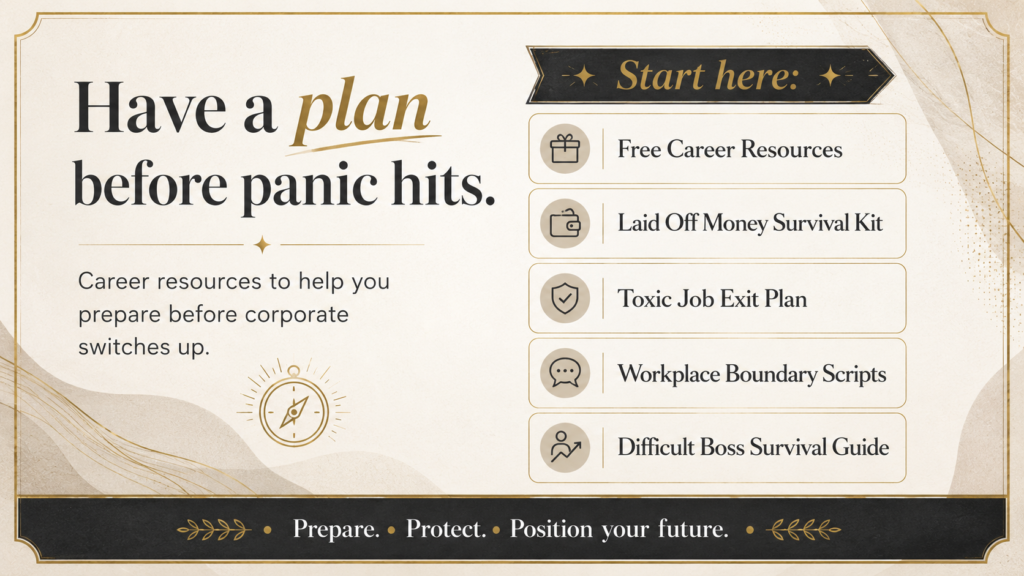
Need help getting organized before panic hits?
Start here:
Free Career Resources: https://builtbynell.com/free-career-resources/
Toxic Job Exit Plan: https://builtbynell.com/product/toxic-job-exit-plan/
Workplace Boundary Scripts: https://builtbynell.com/product/workplace-boundary-scripts/
Difficult Boss Survival Guide: https://builtbynell.com/product/difficult-boss-survival-guide/
Being prepared does not mean it will not hurt
Preparation does not make you emotionless.
You can know everyone is replaceable and still feel hurt when you are replaced.
You can have the resume ready and still feel disappointed.
You can understand corporate politics and still feel angry when you become part of the example.
That does not make you weak.
That makes you human.
A job is not just a job when it is connected to your routine, income, insurance, bills, plans, identity, and the version of yourself you were building.
So the goal is not to become cold.
The goal is to become clear.
Clear enough to care about your work without giving a company ownership over your worth.
Clear enough to be loyal to your responsibilities without being blindly loyal to an organization.
Clear enough to be excellent at what you do without assuming excellence makes you untouchable.
And clear enough to grieve the loss of a role without losing yourself in the process.
That is the balance.
Work aware, not scared
If you take nothing else from this, take this:
Do your job well.
Build your reputation.
Make the money.
Gain the experience.
But do not build your entire identity inside a company that can remove your access before your coffee gets cold.
Keep your resume ready.
Keep your proof folder updated.
Keep your network warm.
Keep your money as protected as possible.
And remember that your career belongs to you.
Not your manager.
Not HR.
Not leadership.
Not the company.
You.
I am not telling you to work scared.
I am telling you to work aware.
Because being good at your job is important.
But being prepared is what gives you options.
And options are what keep you from staying somewhere, begging somewhere, or breaking down somewhere that already showed you they can move on without you.
Need help preparing before corporate switches up?
If you are trying to get your career plan together before panic hits, I created resources to help you organize your next move.
Start with the free resources, then grab the guide that fits where you are right now.
Free Career Resources: https://builtbynell.com/free-career-resources/
Toxic Job Exit Plan: https://builtbynell.com/product/toxic-job-exit-plan/
Workplace Boundary Scripts: https://builtbynell.com/product/workplace-boundary-scripts/
Difficult Boss Survival Guide:https://builtbynell.com/product/difficult-boss-survival-guide/
And if this hit a little too close to home, watch the full YouTube video here: