Is HR On Your Side? What Employees Should Know Before Going to HR
Let’s clear something up.
If you have ever wondered, “Is HR on your side?” the answer is more complicated than most employees realize.
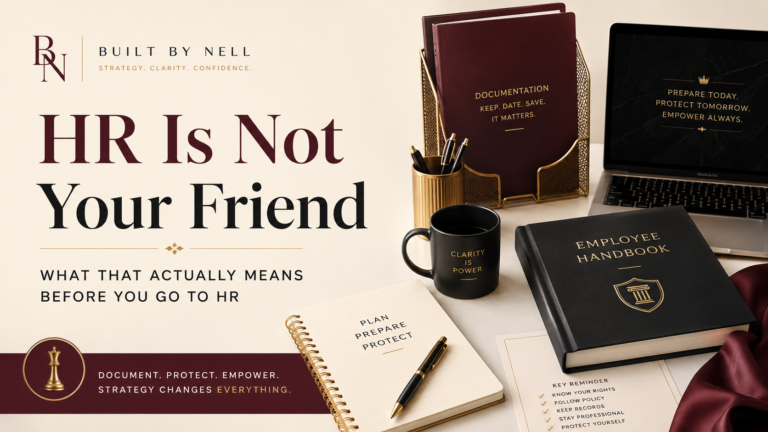
HR is not your personal advocate.
And I say that as someone who has worked in Human Resources for over 10 years.
Now, before somebody starts clutching their employee handbook, this does not mean HR is evil. There are amazing HR professionals out there who genuinely care about employees, fairness, compliance, and doing the right thing.
But a lot of employees misunderstand what HR’s role actually is.
They go to HR thinking they are walking into a safe space where someone is automatically going to take their side.
And friend, that is where things can get tricky.
HR can help you. HR can investigate issues. HR can address policy violations. HR can coach managers. HR can support employees through difficult workplace situations.
But HR’s primary role is to protect the organization.
So when employees ask, “Is HR on your side?” the honest answer is that HR may support you, but HR still works within the company’s structure.
That does not mean you should never go to HR. It means you need to understand how HR works before you walk in with no documentation, no strategy, and pure vibes.
Because vibes are cute.
But vibes are not a paper trail.
Watch the full video
I broke this topic down in my latest YouTube video because so many employees are navigating workplace issues without understanding how the system actually works.
In the video, I explain what HR actually does, when HR can help, and how employees can protect themselves before escalating workplace issues.
What does HR actually do?
HR is a business function.
That means HR exists to help the company manage employees, reduce legal risk, maintain compliance, support leadership, apply policies, and handle workplace concerns appropriately.
So when you bring an issue to HR, they are not only thinking about how you feel.
They are also looking at questions like:
- Was there a policy violation?
- Is there a legal or compliance risk?
- Is there documentation?
- Are there witnesses?
- Is there a pattern?
- Has this been reported before?
- Does leadership need to get involved?
- What does the company need to do to protect itself?
That is why going to HR can feel very different from what employees expect.
You may be looking for emotional validation.
HR is looking for facts, documentation, timelines, policies, and risk.
That gap is where a lot of employees end up feeling blindsided.
Is HR On Your Side or the Company’s Side?
Here is the honest answer:
HR protects the company first.
That does not mean HR can never support employees. It means HR’s first responsibility is to the organization.
So yes, HR may help you.
They may investigate your complaint. They may discipline a manager. They may support an accommodation request. They may step in if there is harassment, discrimination, retaliation, or a serious policy violation.
But HR is not your personal representative.
They are not your lawyer.
They are not your therapist.
They are not your workplace bestie.
They are part of the company’s structure.
Once you understand that, you stop being shocked by how HR responds and you start moving more strategically.
Understanding whether HR is on your side starts with understanding what HR can and cannot do.
Should you go to HR about your boss?
Sometimes, yes.
This is why I do not like blanket advice like, “Never go to HR.”
That is too simple, and honestly, it can be bad advice.
There are situations where HR absolutely should be involved.
You may need to go to HR if you are dealing with:
- Harassment
- Discrimination
- Retaliation
- Safety concerns
- Wage or pay issues
- Accommodation requests
- Leave of absence issues
- Policy violations
- Manager misconduct
- A documented pattern of mistreatment
But before you go, you need to get clear on what you are reporting.
Saying “my boss is toxic” may be true, but HR needs more than that.
What did your boss do?
When did it happen?
Was it in writing?
Were there witnesses?
Did it happen more than once?
Did you report it before?
Did anything change after you spoke up?
That is the difference between venting and reporting.
And in corporate life, that difference matters.
What should you document before going to HR?
Before going to HR, start documenting.
Do not wait until the situation is completely out of control. Start keeping track as soon as you notice a pattern or serious issue.
Here is what you should document:
- Dates and times of incidents
- Names of people involved
- Witnesses
- What was said or done
- Emails, messages, screenshots, or written communication
- Any relevant policies
- Changes in treatment after you raised a concern
- Sudden performance issues after speaking up
- Any repeated patterns
You do not need to write a dramatic novel.
You need a clear timeline.
For example, instead of saying:
“My manager keeps targeting me.”
A stronger version would be:
“On May 4, during our team meeting, my manager criticized my work in front of the team. After I asked for clarification, I was removed from a project I had been leading since March. I have emails showing my previous involvement and the timeline of the change.”
See the difference?
One is a feeling.
The other is a documented concern.
Your feelings may be valid, but documentation helps support what you are saying.
What should you avoid saying to HR?
When you go to HR, be careful with how you explain the issue.
That does not mean you need to be fake. It means you need to be intentional.
Avoid going in with vague statements like:
- “My manager is toxic.”
- “Everyone knows they are a problem.”
- “This company is terrible.”
- “They are targeting me.”
- “I am going to sue.”
- “I hate working here.”
Even if some of that feels true, it may not help your case.
Instead, focus on facts.
Try saying:
“I would like to report a pattern of behavior that is affecting my ability to do my job. I have documented several examples, including dates, witnesses, and written communication.”
Or:
“After I raised a concern on [date], I noticed changes in how I was treated. I am concerned this may be retaliation and would like guidance on the appropriate next steps.”
That sounds clear.
That sounds professional.
That gives HR something to review.
And most importantly, it protects you from walking into a serious workplace conversation unprepared.
The biggest mistake employees make with HR
The biggest mistake employees make is going to HR with emotions but no evidence.
And listen, I get it.
If you are dealing with a difficult manager, workplace drama, favoritism, retaliation, or disrespect, of course you are emotional.
You are human.
But when you go to HR, you need to bring more than frustration.
You need facts.
You need examples.
You need dates.
You need documentation.
You need to know what outcome you are looking for.
Because if you go to HR and say, “I just feel like something is off,” HR may not have enough to act on.
But if you say, “Here is what happened, here is when it happened, here is who witnessed it, here is the policy I believe was violated, and here is the pattern I have documented,” that is a very different conversation.
Same concern.
Stronger delivery.
How to protect yourself before going to HR
Protecting yourself at work does not mean being paranoid.
It means being prepared.
Before going to HR, ask yourself:
- What happened?
- When did it happen?
- Who was involved?
- Is there documentation?
- Is there a policy connected to this issue?
- Has this happened more than once?
- What outcome am I asking for?
- Is this something HR can actually address?
You should also follow up important verbal conversations in writing.
For example:
“Hi [Name], I wanted to follow up on our conversation from today regarding [topic]. My understanding is [summary]. Please let me know if I misunderstood anything.”
That kind of email may feel small, but it creates a record.
And in the workplace, records matter.
Final thoughts: HR can help, but move smart
HR is not your personal advocate.
But that does not mean you are powerless.
It means you need to understand the room you are walking into.
HR can be helpful in the right situations. But if you go in unprepared, emotional, vague, or without documentation, you may not get the outcome you are hoping for.
So before you go to HR, document the facts.
Know the policy.
Be clear about the issue.
Think about the outcome you want.
And please, for the love of your career, stop going into serious workplace conversations with vibes and a prayer.
Vibes are not documentation.
A prayer is not a paper trail.
Move smarter.
Your career deserves that.
Free career resource
If this topic hit a little too close to home, I created a free resource to help you navigate corporate life with more clarity.
Download:
The Blueprint: 5 Corporate Truths They Don’t Teach You Until You Learn Them the Hard Way
You can also check out my workplace and career guides here:
Related reads coming soon
If you want more workplace survival content, these are the kinds of posts I’ll be adding soon:
- What to Document Before Going to HR
- What to Say When You Report a Toxic Boss
- Signs Your Company May Be Preparing for Layoffs
- How to Protect Yourself in a Toxic Workplace
- What Employees Should Know Before Quitting Their Job
We are not just surviving corporate life over here.
We are learning the game, protecting our peace, and moving smarter.