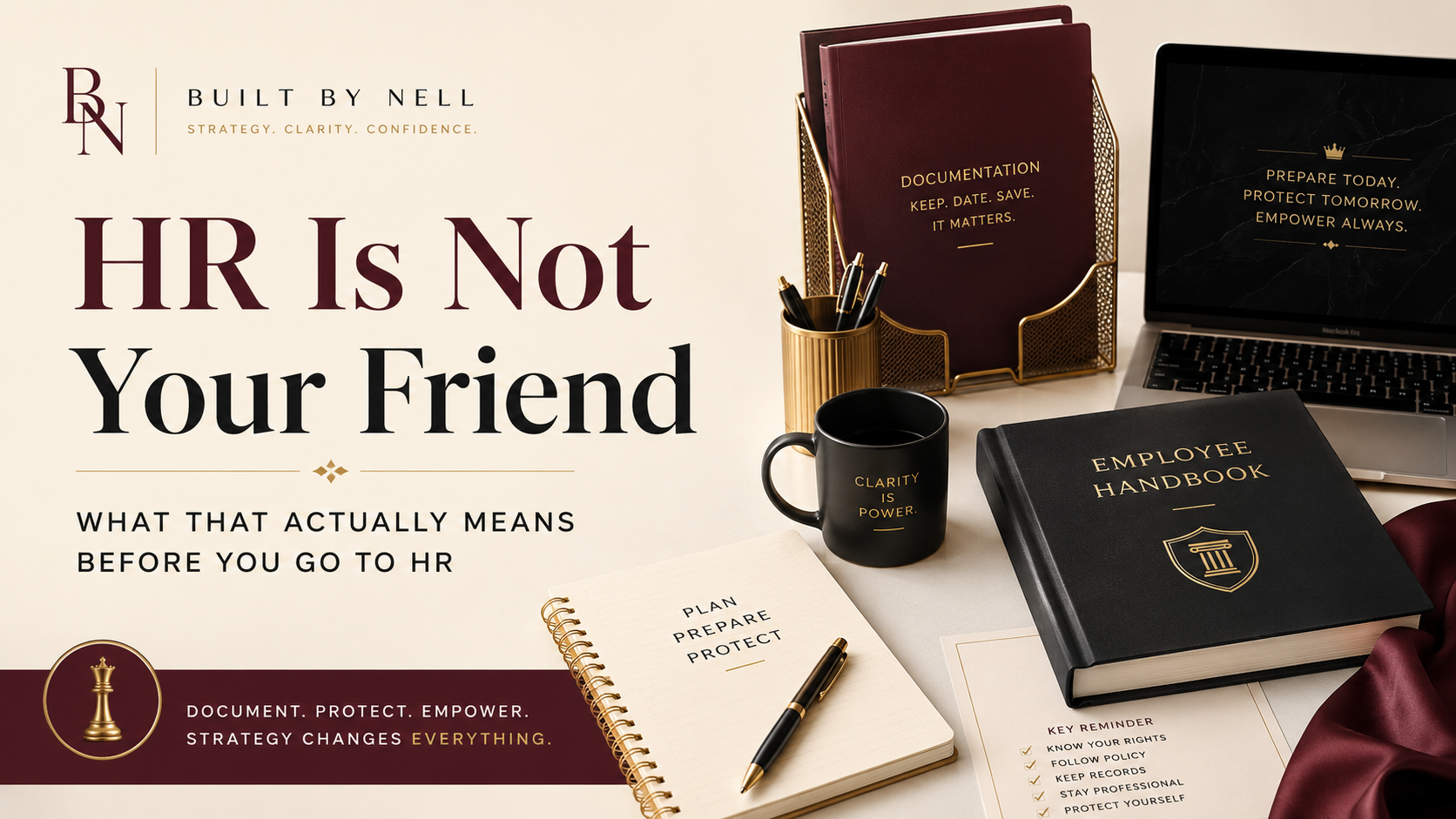
HR Is Not Your Friend: What That Actually Means Before You Go to HR
HR is not your friend, and once you truly understand what that means, you can stop navigating workplace issues with confusion and start moving with strategy.
After posting my last corporate truths video, apparently a lot of people agreed, because the comments were full of workplace stories, HR horror stories, and employees realizing they’d learned that lesson the hard way.
But let’s be clear.
This is not HR slander.
There are amazing HR professionals out there. There are people in HR who genuinely care about employees, fairness, compliance, and doing the right thing.
But employees are often given a very misleading understanding of what HR’s role actually is.
HR is not your personal advocate.
HR is not your therapist.
HR is not your best friend.
HR is not your personal defense attorney.
HR is a business function.
And once you understand that, you can stop navigating workplace issues in confusion and start moving with a strategy.
Because going to HR with feelings but no facts is not a strategy.
It is a gamble.
And friend, we are not gambling with our careers over here.
Prefer to watch instead?
I broke this down in my latest YouTube video, especially after seeing how many people related to the conversation around HR not being your personal advocate.
If you prefer listening or watching, start there. But if you want the deeper breakdown, keep reading because we need to talk about what “HR is not your friend” actually means and how to protect yourself at work.
What people mean when they say “HR is not your friend”
When people say “HR is not your friend,” they are usually trying to say:
Do not assume HR is automatically on your side.
That does not mean HR hates employees.
That does not mean HR can never help you.
That does not mean every HR person is sitting in an office plotting against workers like a corporate Disney villain.
It means HR’s first responsibility is to the organization.
HR is hired by the company to help manage people, reduce risk, support compliance, maintain policies, guide leadership, and address workplace issues in ways that protect the business.
Sometimes protecting the company also means helping you.
For example, if you report harassment, discrimination, retaliation, unsafe working conditions, or a serious policy violation, HR may need to investigate and take action.
But even then, HR’s job is to investigate the facts.
Not automatically take your side.
That difference matters.
HR can care about you and still protect the company first
This is where people get confused.
An HR person can care about you as a person and still have a job to do.
Both things can be true.
They may feel bad about what you are experiencing.
They may believe the workplace issue needs to be addressed.
They may even agree that your manager is moving wild.
But HR still has to look at the situation through a company lens.
That means they are asking questions like:
- Is there a policy violation?
- Is there documentation?
- Is there a legal risk?
- Is there a pattern?
- Are there witnesses?
- Has this been reported before?
- What does the company need to do next?
- What risk does this create for the organization?
You may walk into HR wanting comfort.
HR is walking into the conversation thinking about facts, policy, process, and liability.
That does not make them evil.
It makes their role different from what many employees expect.
The biggest mistake employees make when going to HR
The biggest mistake employees make is treating HR like a therapist, best friend, or personal attorney.
And listen, I get why it happens.
Workplace issues can be emotional.
If your manager is disrespectful, if your workload is unreasonable, if you feel targeted, if you are being excluded, if you are dealing with office politics, or if you feel like leadership is playing in your face, of course, you are going to be upset.
You are human.
But when you go to HR, you need more than emotion.
You need facts.
You need documentation.
You need a timeline.
You need examples.
You need to know what outcome you are asking for.
Because walking into HR and saying, “My boss is toxic,” may be true, but it is not enough.
What did your boss do?
When did it happen?
Was it in writing?
Were there witnesses?
Did it happen more than once?
Did you report it before?
Did anything change after you spoke up?
Did it affect your job, pay, schedule, workload, performance review, or opportunities?
That is the kind of information HR needs to evaluate the situation.
Your feelings may be valid.
But documentation is what helps support the concern.

When HR can actually help employees
Now, let’s be fair.
HR can absolutely help in certain situations.
This is why I do not agree with blanket advice like, “Never go to HR.”
That advice sounds edgy, but it is not always smart.
There are times when HR needs to be involved.
You may need to go to HR if you are dealing with:
- Harassment
- Discrimination
- Retaliation
- Unsafe working conditions
- Wage or pay issues
- Leave of absence concerns
- Reasonable accommodation requests
- Serious policy violations
- Benefits issues
- Manager misconduct
- A documented pattern of mistreatment
But even in those situations, HR is not there to automatically pick a side.
HR is there to review the issue, assess risk, investigate facts, apply policy, and determine what action the company should take.
That is why preparation matters.
If you are going to HR, do not just go in angry.
Go in clear.
Go in factual.
Go in documented.
Go in knowing what you want to happen next.
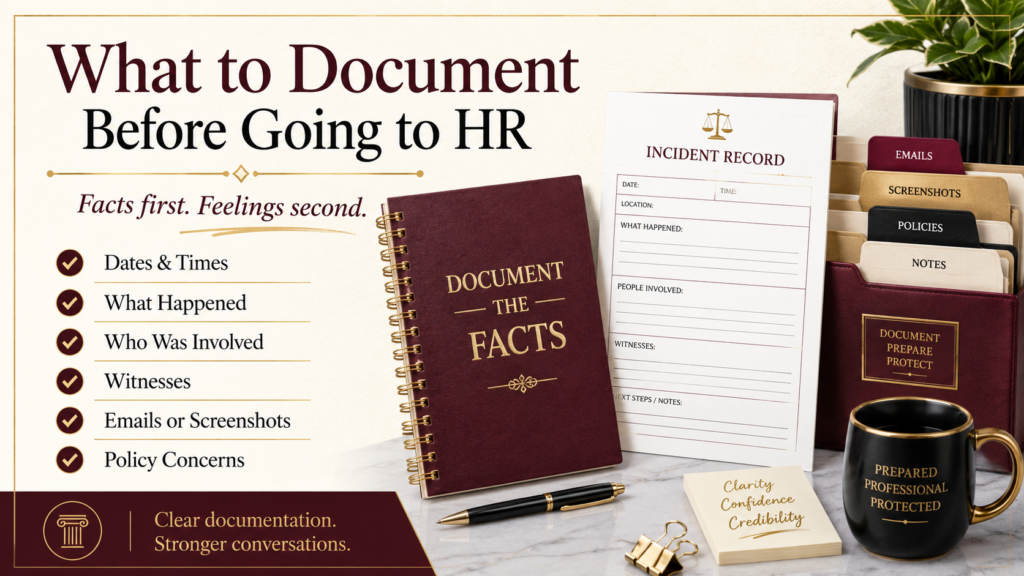
What to document before going to HR
Before you go to HR, start building your paper trail.
And no, this does not mean you need to create a dramatic 47-page workplace memoir called “My Manager Is Ruining My Life.”
It means you need a clear record.
Document:
- Dates and times
- What happened
- Who was involved
- Who witnessed it
- Emails, messages, screenshots, or meeting notes
- Any relevant policy
- Any changes after you raised a concern
- Repeated patterns
- How the issue affected your work
For example, instead of saying:
“My manager is targeting me.”
Try documenting:
“On March 12, I raised a concern about my workload during our one-on-one meeting. On March 15, I was removed from a project I had been leading since January without explanation. I have email records showing my previous involvement and the timeline of the change.”
See the difference?
One is a feeling.
The other gives facts, dates, and context.
That is how you move smarter.
What not to say when you go to HR
Please do not walk into HR and say every thought that has been sitting in your spirit for the past six months.
I know you want to.
I know your notes app is probably tired.
But you need to be intentional.
Avoid saying things like:
- “My boss is toxic.”
- “Everybody knows they are a problem.”
- “This company is terrible.”
- “I hate working here.”
- “I’m going to sue.”
- “Nobody here knows what they are doing.”
- “HR never helps anybody anyway.”
Even if some of that feels true, it may not help you.
Instead, say something like:
“I would like to report a workplace concern and provide documentation of what has happened. I am looking for guidance on the appropriate next steps.”
Or:
“I am concerned about a pattern of behavior that may be affecting my ability to do my job. I have documented specific examples and would like this reviewed.”
Or:
“After I raised a concern on [date], I noticed changes in how I was treated. I am concerned this may be retaliation and would like to understand the process for reviewing this.”
That sounds different.
That sounds prepared.
That gives HR something to actually work with.
Know what outcome you are asking for
A lot of employees go to HR because they are frustrated, but they have not thought about what they actually want.
Do you want the behavior to stop?
Do you want a schedule adjustment?
Do you want an investigation?
Do you want clarification on a policy?
Do you want documentation on file?
Do you want mediation?
Do you want to report retaliation?
Do you want to request an accommodation?
Do you want to transfer departments?
Do you want guidance before deciding whether to resign?
You do not need to have the perfect answer, but you should have some idea of what resolution looks like.
Because if you go in with, “I just want something done,” HR may not know what you are actually asking for.
And when the issue is serious, vague requests can weaken your position.
Be clear.
Be specific.
Be professional.
This is your career, not a group chat.
Understanding HR’s role does not make you cynical
Some people hear this and think, “So basically, trust no one.”
That is not what I am saying.
Understanding HR’s role does not make you cynical.
It makes you strategic.
You can respect HR and still understand the system.
You can report serious issues and still protect yourself.
You can speak up and still be careful with your words.
You can advocate for yourself without oversharing, spiraling, or walking into the conversation unprepared.
The goal is not fear.
The goal is clarity.
Because when you understand the system, you stop being shocked by it.
And when you stop being shocked by it, you can move smarter.
The real lesson: protect yourself before things get messy
If there is one thing I want employees to take from this, it is this:
Do not wait until things are already on fire to start protecting yourself.
Keep records.
Know your policies.
Follow up in writing.
Be careful what you say.
Think before you escalate.
Ask clear questions.
Know what outcome you want.
And when you do go to HR, go in with facts over feelings.
Again, your feelings matter.
But feelings alone are not a workplace strategy.
Documentation, clarity, and timing matter.
Need help figuring out what to say at work?
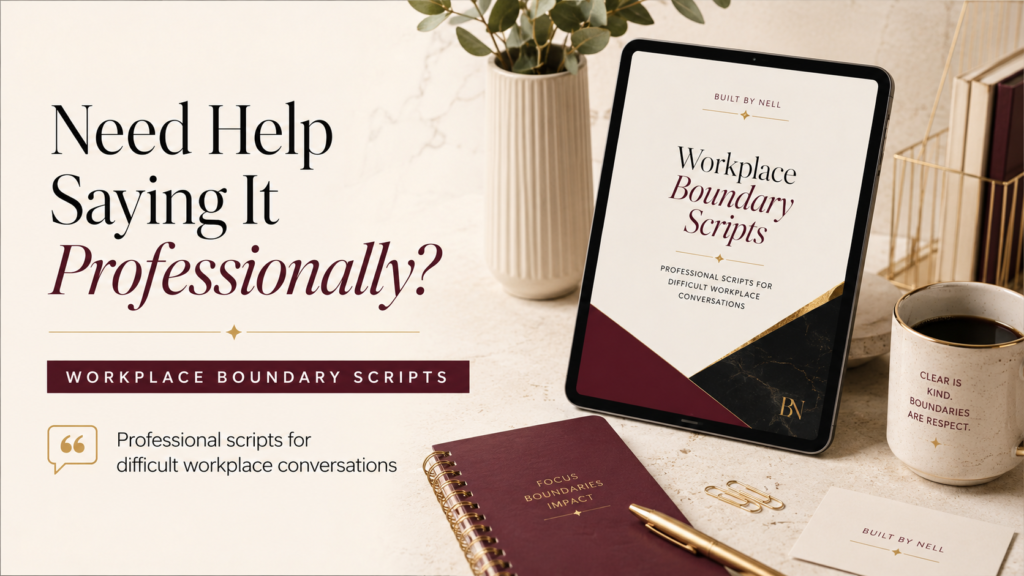
If your biggest issue is not knowing how to say things professionally without sounding rude, emotional, or like you are about to crash out in Outlook, my Workplace Boundary Scripts guide may help.
It gives you professional scripts for difficult workplace conversations, including how to say no, push back respectfully, set boundaries, and communicate more clearly at work.
Because sometimes the issue is not that you do not know what you feel.
It is that you need help saying it in a way that protects you.
And that matters.
Final thoughts
HR is not your friend.
But that does not mean HR is your enemy.
It means HR has a role, and you need to understand that role before you walk into a serious workplace conversation.
HR may care.
HR may help.
HR may investigate.
HR may take action.
But HR’s job is to protect the organization first.
Sometimes that aligns with helping you.
Sometimes it does not.
So before you go to HR, document everything.
Stick to facts over emotion.
Know what outcome you are asking for.
And understand that HR may not resolve things the way you hoped.
That does not mean you are powerless.
It means you need to move strategically.
And if you are trying to survive corporate without learning every lesson the hard way, this is exactly why I am building this platform.
We have a lot more to talk about.
Related resources
Watch the full YouTube video:
https://www.youtube.com/watch?v=PyEPJUQGRH0&t=14s
Download my free career resource:
The Blueprint: 5 Corporate Truths They Don’t Teach You Until You Learn Them the Hard Way
https://builtbynell.com/free-career-resources/
Shop workplace and career guides:
https://builtbynell.com/shop/
Recommended guide:
Workplace Boundary Scripts
https://builtbynell.com/product/workplace-boundary-scripts/