I Accidentally Built Myself Another Toxic Job: How I’m Using AI to Rebuild My Business
Learning how to delegate tasks with AI has become one of the biggest parts of rebuilding my business after a layoff. Content creation, copywriting, Pinterest, research, scheduling, admin, customer service. I quietly hired myself for five different jobs and forgot to pay any of them in time or rest.
I didn’t recognize the burnout because I’d built it. It just had better branding this time.
The boss was me.
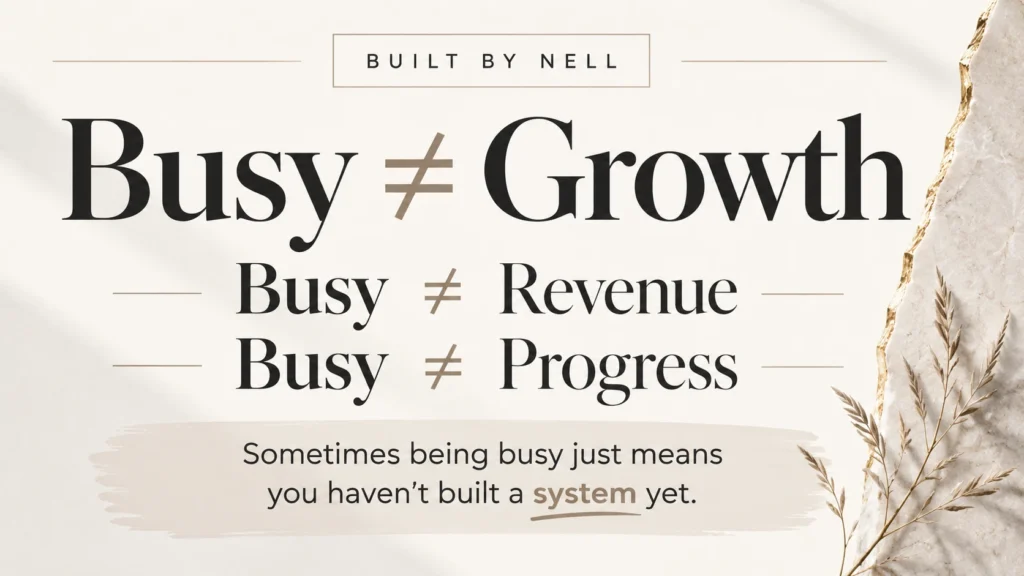
Busy Is Not the Same as Growth
Here’s the trap, and if you’re a creator, solopreneur, or small business owner, you already know it. Being busy feels productive. Answering every DM at 11pm, formatting your own blog posts, manually scheduling every pin, it all feels like proof you’re serious about this. Like the exhaustion is the receipt.
Except busy isn’t a metric. Revenue is a metric. Growth is a metric. Getting your best work in front of the right people is a metric. I could be busy for twelve hours and move the business forward by exactly zero dollars, because I spent that time reformatting a spreadsheet instead of doing the one thing only I can do.
The Real Problem Wasn’t AI. It Was Control
I want to be honest about something. My resistance to handing anything off was never really about not having help available. It was control. I spent over a decade in HR watching what happens when things get done wrong: sloppy handoffs, missed details, work that boomerangs back as a bigger problem than if someone had just done it right the first time. So I built a business where I trusted exactly one person to do anything correctly. Me.
That instinct made sense in a corporate building where other people’s names were on the outcomes. It makes a lot less sense now that I’m the one deciding what “correctly” even means, and I’m the bottleneck standing between me and my own income. For me, learning how to delegate tasks with AI is less about giving up control and more about deciding where my attention is actually needed.
AI hasn’t fixed that, and I’m not going to tell you it has. What it’s starting to let me test is whether I can loosen my grip on a task without actually losing oversight of it. That’s the experiment. It is not a finished result.
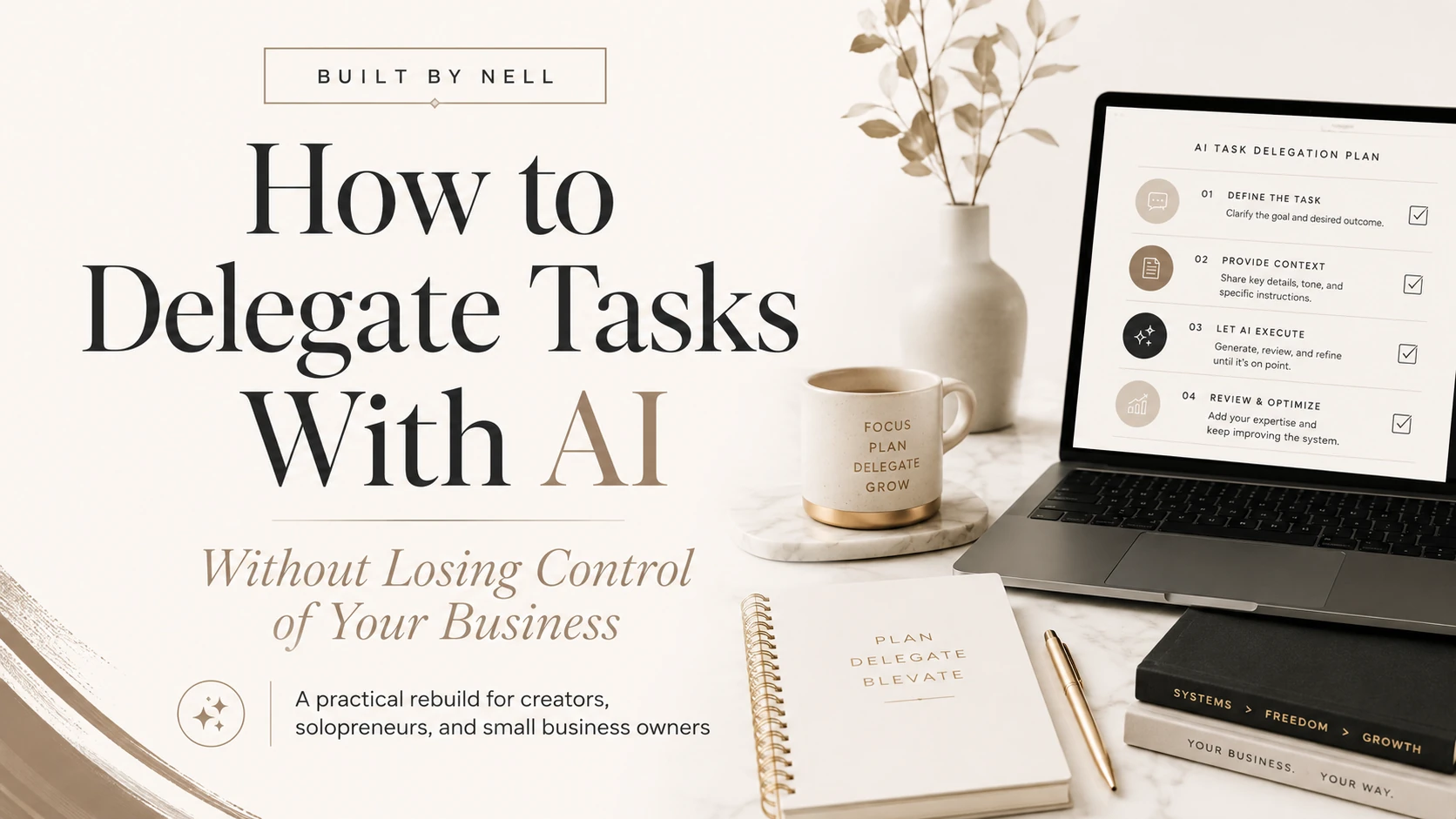
How to Delegate Tasks With AI: The Three Questions I Use
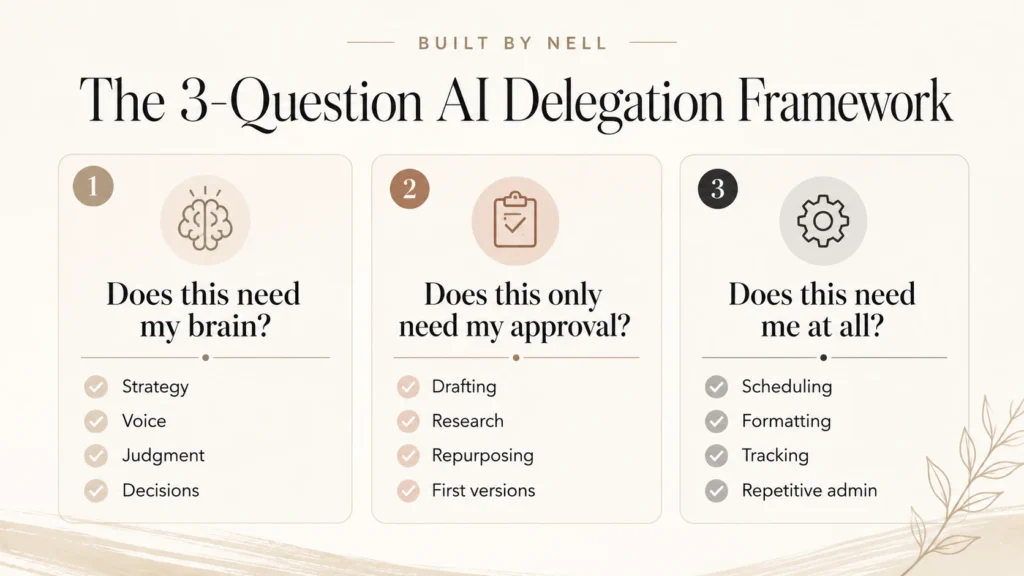
I’m sorting every task in my business into one of three buckets. This is how I’m learning to delegate tasks with AI without pretending I’ve got it all figured out.
Does this need my brain?
Strategy, voice, anything where the outcome depends on judgment I can’t hand off. What this business actually stands for, what a client needs versus what they’re asking for, the final pass on anything with my name attached. AI can draft around this. It cannot replace it.
Does this only need my approval?
This is the middle bucket, and it’s where most of my workload has actually been living. A first draft of a caption. A researched outline. A batch of Pinterest descriptions. The idea is that AI builds a first version, I read it, cut whatever doesn’t sound like me, and approve it. I’m trying to become the filter instead of the typist. I’m not all the way there yet.
Does this need me at all?
Scheduling. Formatting. Sorting research into something usable. Repurposing one piece of content into five smaller ones. This is the bucket I’m still fighting hardest to actually hand over, because “I could just do it faster myself” is a lie I’ve told myself for months. I probably could do it faster. That’s not the same as it being the best use of the only hours I have.
What This Actually Looks Like So Far
I want to be straight about where this actually stands instead of making it sound tidier than it is. I am not running a smooth, automated operation. I started sorting my work into these three buckets recently, and most days that just means catching myself mid-task and asking which bucket this actually belongs in, then course-correcting.
This shift is bigger than my own business too. More solopreneurs are exploring how AI can take repetitive work off their plates without immediately hiring a full team.
Some things I handed off came back needing more editing than I expected. Some tasks I was sure belonged in “doesn’t need me” turned out to need more of my brain than I gave them credit for, so I pulled them back. I don’t have a before-and-after number for you, because I don’t have one yet. This is early. It’s a rebuild in progress, not a highlight reel.
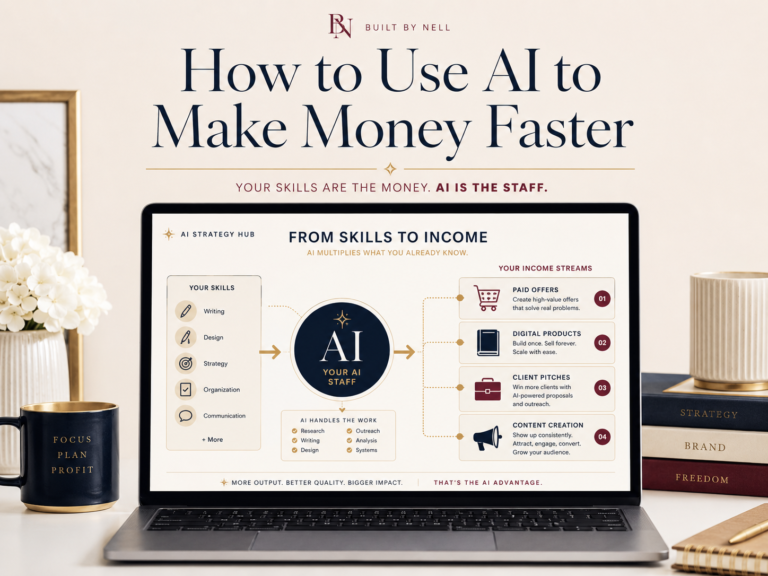
If you want the more tactical side of what I’m building toward, I broke down five practical systems for using AI to make money faster, including where delegating tasks with AI is supposed to fit.
What I’m Not Saying
I’m not saying AI runs my business. I’m not saying I’ve got this figured out, or that I’ve replaced a team, or that income has 10x because I found the right prompt.
What I am saying is that the version of me who believed doing everything herself was the price of being taken seriously was making this harder than it needed to be. That belief is exactly what had me white-knuckling content creation until it fell apart instead of building something I could actually sustain.
Where I’m Starting, and Where You Can Too
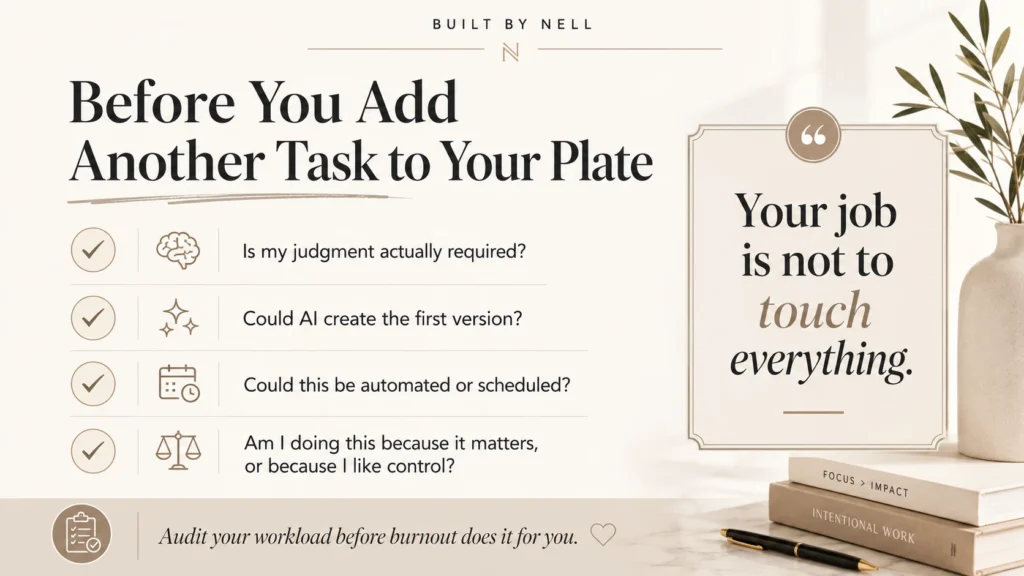
If any of this sounds familiar- the overwhelm dressed up as ambition, the refusal to hand anything off because you’re not sure it’ll be done “right,” start with the same three questions I’m using. Not with a tool. With an honest look at where your hours are actually going and which of those hours needed you specifically.
If you’re staring at your own version of this list and don’t know where to start sorting it, that’s exactly the gap the AI Content & Income Strategy Intensive is built to fill. Not a pile of generic prompts. An actual look at your workload and what to hand off first. The goal is not to figure out how to delegate tasks with AI so I can disappear from my business. The goal is to stop being the bottleneck in every part of it.
I’ve already had to rethink what work and stability look like after a layoff. This time, I’m also rethinking what building a business is supposed to look like. I’m not trying to prove I can do everything myself anymore. I’m trying to build something I can actually sustain.