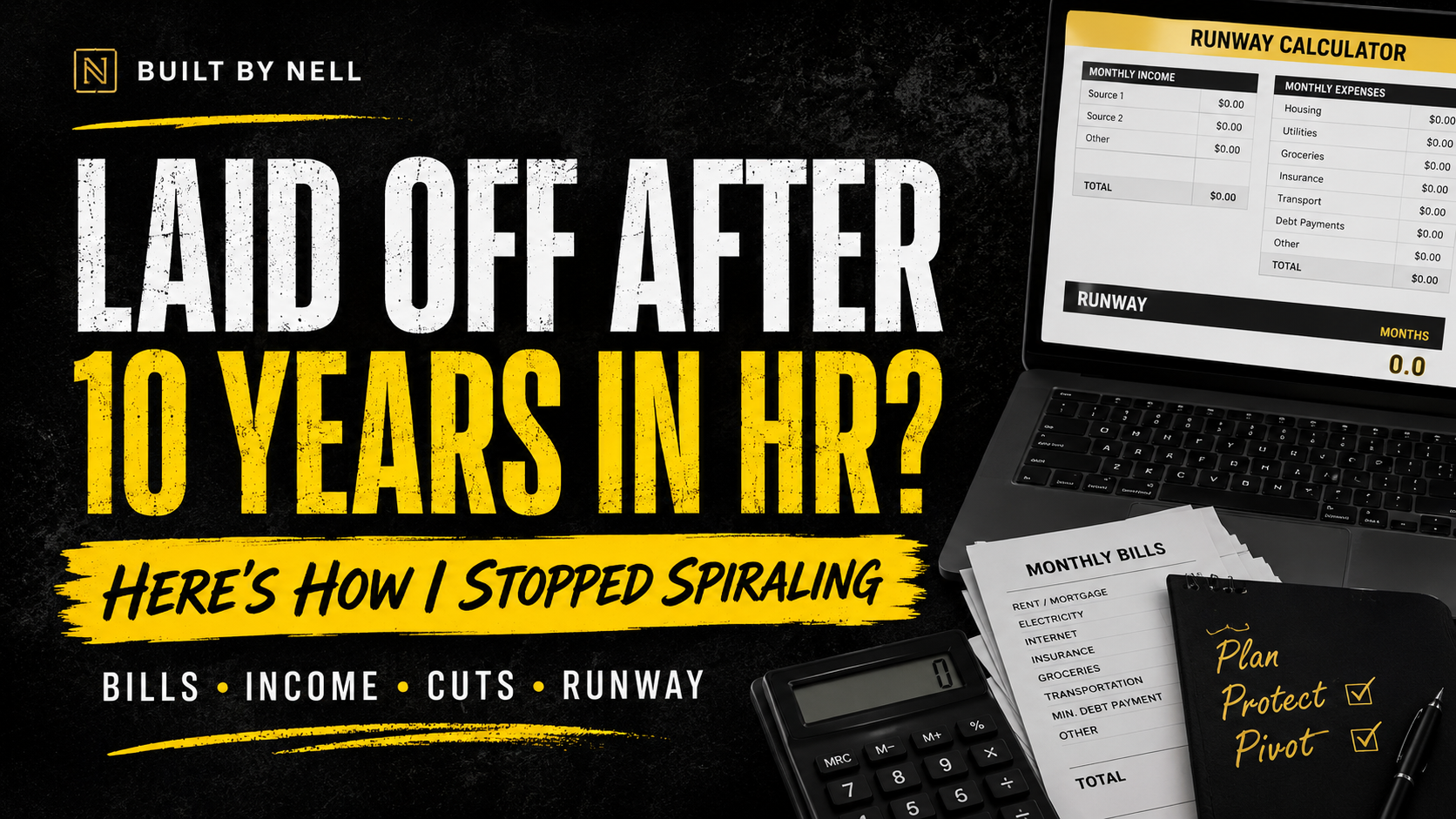
Laid Off After 10 Years in HR? Here’s How I Stopped Spiraling
Getting laid off after 10 years in HR hit me harder than I expected.
And that’s the part I need to be honest about.
I knew how corporate worked. I understood that layoffs happen. I understood that sometimes decisions are made on paper, in spreadsheets, in budget meetings, and in rooms where your actual effort does not get the final vote.
But knowing all of that did not stop me from taking it personally.
Because when you know you were good at your job, when you received positive feedback, when you showed up, supported people, carried responsibility, and still got hit with a layoff, your brain starts doing detective work.
Every meeting becomes a clue.
Every weird email becomes evidence.
Every shift in energy becomes a full investigation.
And honestly?
Sometimes it still does not make sense.
A layoff may be a business decision on paper, but when it happens to you, it can feel deeply personal.
Especially when you start thinking about the things that felt off.
Prefer to watch instead of read? I broke this full story down in the video below, including the layoff money breakdown that helped me stop spiraling and move from panic to strategy.
Why Getting Laid Off Felt Personal
For me, I had concerns.
I had concerns about retaliation. I had concerns about being the only woman of color in leadership. And I am not here to make claims I cannot fully prove in a blog post or on YouTube.
But I will say this.
If something feels off, document it.
Ask questions.
Get advice early.
And do not let embarrassment make you stay quiet.
Sometimes “being professional” turns into suffering silently.
And no, we are not doing that anymore.
Being laid off can bring up shame, confusion, anger, embarrassment, grief, and fear all at the same time. It is not just about losing a job. It is about losing structure, income, routine, identity, and sometimes the version of yourself you thought you were building toward.
That part deserves honesty.
I Took A Trip After My Layoff, But The Layoff Was Still Waiting For Me
After my layoff, I took a trip to Italy.
Some people would have canceled. I did not.
I needed to breathe. I needed space. I needed to remember that my life was bigger than a job title.
And the trip helped.
But here is the part people do not always say out loud.
A distraction is not the same as processing.
When I came back home, the layoff was still there like, “Hey girl. Miss me?”
Rude.
The trip gave me space, but it did not erase the reality waiting for me. I still had to figure out what came next. I still had to look at my money. I still had to decide how long I could realistically breathe before panic started running the meeting.
The Part I Did Not Expect: Isolation
I also isolated.
The first person I told was my partner. The second person I told was my mom. But I did not tell one of my close friends until almost a month later.
Not because I did not trust them.
Because I was embarrassed.
I felt disappointed. I felt like I failed. Even though I knew, logically, a layoff did not mean I failed.
But feelings do not always read the policy manual.
Keeping it to myself made it worse. Because when you do not talk about it, your mind becomes the group chat. And my mind was giving terrible advice.
That is why I believe one of the first things you need after a layoff is not just a resume update.
You need clarity.
Emotional clarity.
Financial clarity.
Next-step clarity.
Because panic loves confusion.
What Helped Me Stop Spiraling After My Layoff
What helped me was not pretending I was fine.
It was not panic applying to every job with an Easy Apply button.
It was not trying to rebuild my entire life before dinner.
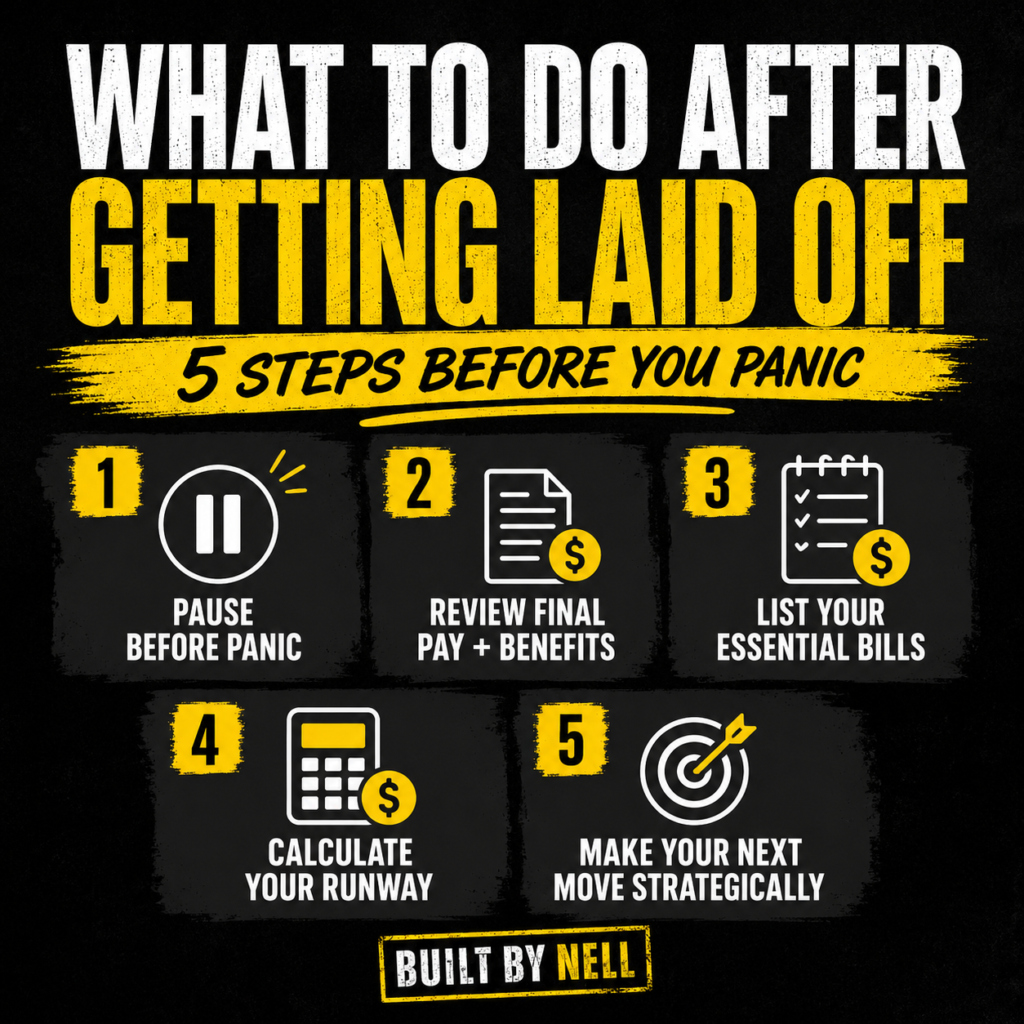
What helped was the math.
I needed to know my number.
I needed to know:
What money do I have access to?
What income is still coming in?
What bills actually have to be paid?
What can I temporarily cut?
How much time do I actually have?
Because after a layoff, your brain will tell you everything is urgent.
Apply everywhere.
Fix everything.
Update LinkedIn.
Find your purpose by Tuesday.
Absolutely not.
Before you make your next move, you need your runway.
Need help figuring out your own layoff runway?
The Laid Off Money Survival Kit includes a guide, spreadsheet, runway calculator, bills and cuts tracker, 30-day plan, and copy-paste scripts to help you organize your next move after a layoff.
What Is A Layoff Runway?
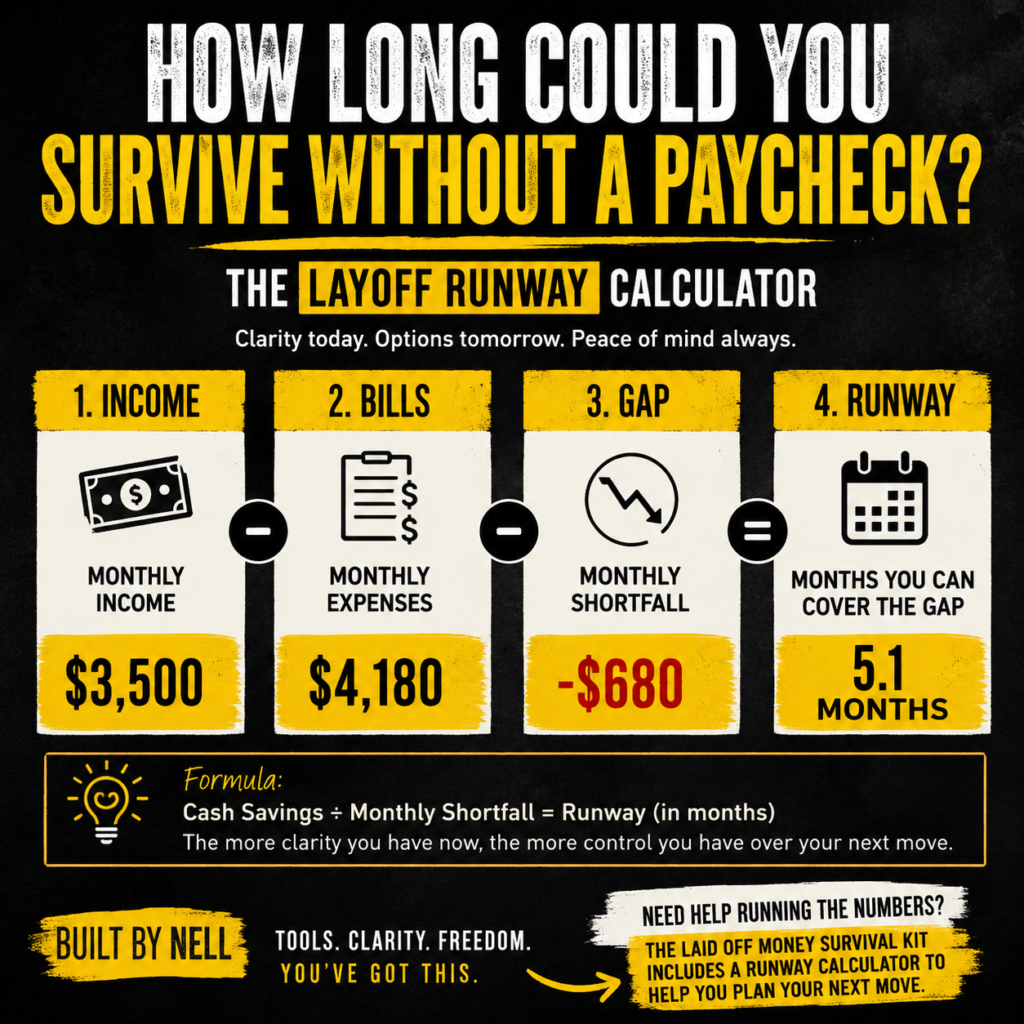
Your layoff runway is the amount of time you can cover your expenses while your income is interrupted or reduced.
It is not meant to scare you.
It is meant to give you a planning window.
For example, if you know your savings, unemployment income, expected income, monthly bills, and possible cuts, you can get a clearer picture of how many months you have before things get tight.
That number matters because it changes how you move.
If your runway is short, you may need to cut faster, apply more aggressively, negotiate bills, take temporary work, or bring in extra income.
If your runway is longer, you may have more room to be strategic, apply selectively, rebuild your materials, or create another income stream.
Either way, the number helps.
Because vague anxiety will have you panicking over everything.
Math gives the panic a name.

A Simple Layoff Money Breakdown
Here is the kind of breakdown that helped me calm down.
Let’s say someone has:
$14,000 in available cash
$2,675 in monthly income
$4,815 in monthly expenses
If they cut nothing, their monthly gap may be around $2,140.
That gives them about 6.5 months of breathing room.
And listen, 6.5 months is not nothing.
But when you are unemployed, that number can still feel tight.
Because you do not know how long the job search will take. You do not know how fast companies will move. You do not know how many interviews will turn into actual offers.
That is where planned cuts matter.
Not forever cuts.
Temporary cuts.
Eating out. Shopping. Extra subscriptions. Fun money. Beauty extras. Anything that makes sense for your life.
If that same person adds $1,000 in planned monthly cuts, their monthly gap gets smaller, and their runway gets longer.
In this example, the runway could move from about 6.5 months to about 12.3 months.
That does not magically fix the layoff.
It does not make the disappointment disappear.
But it can calm the panic.
Because now the situation changes from:
“Everything is on fire.”
To:
“I have a window, but I need to move smart.”
That is the point.

If you are trying to stop spiraling after a layoff, start with your numbers.
Use the Laid Off Money Survival Kit to organize your bills, income, cuts, runway, and next steps in one place.
After A Layoff, You Do Not Just Need Motivation. You Need Math.
Cute quotes are nice.
But a runway calculator will tell you if you need to breathe, budget, negotiate, or start selling furniture.
And I am not trying to sell my couch, so we needed a plan.
That is why I created the Laid Off Money Survival Kit.
Because after my layoff, I did not need another “you got this” post.
I needed one place to see my bills, my income, my cuts, my runway, and the scripts I could use when I needed to contact HR, bill providers, recruiters, or former coworkers without sounding like I was unraveling in 4K.
Get The Laid Off Money Survival Kit
If you were recently laid off or you are worried about a possible layoff, I created the Laid Off Money Survival Kit to help you organize your next move.
The kit includes:
A layoff survival guide
A spreadsheet
A runway calculator
A bills and cuts tracker
A 30-day stabilization plan
Copy-paste scripts for HR, bill providers, recruiters, networking, and more
It is not legal advice.
It is not financial advice.
It is a practical tool to help you stop guessing, organize your numbers, and move with more clarity.

Get the Laid Off Money Survival Kit here:
Why Unemployment Should Be Part Of The Plan, Not The Whole Plan
Unemployment may be part of your layoff plan, but it should not be the only thing you look at.
After my layoff, I had to think through every possible income lane I already had access to.
YouTube.
Brand deals.
Affiliate income.
My website.
Digital products.
Not because any of those things are easy. They are not.
But because I had to stop thinking only in terms of replacing one job with another job.
Sometimes the first goal is stability.
Then strategy.
A layoff forces you to ask hard questions about your money, your career, your skills, and how much power you want one employer to have over your life.
That is uncomfortable, but it can also be clarifying.
Watch The Full Video
If you want the full story, I broke this down in my YouTube video, including the emotional side of getting laid off, why I took it personally, how isolation made it worse, and how the money breakdown helped me stop spiraling.
Want More HR Insider Career Strategy?
If you want more practical career strategy from an HR insider, grab my free Built By Nell Blueprint.
The Blueprint breaks down five corporate truths they do not teach you until you learn them the hard way.

Final Reminder If You Were Recently Laid Off
If you were recently laid off, please hear me.
This is not proof that you failed.
A company making a decision about your position does not erase your talent. It does not erase your experience. It does not erase what you brought to the table.
But you do need a plan.
Not because you should be scared.
Because clarity gives you options.
So before you panic apply to every job with an Easy Apply button, sit down and figure out your runway.
What do you have?
What do you need?
What can wait?
What can be cut?
What income can you use or create?
Start there.
One step at a time.
Not everything at once.
If you were recently laid off, do not try to organize everything in your head.
Get the Laid Off Money Survival Kit and use the guide, spreadsheet, runway calculator, and scripts to make your next move with clarity.