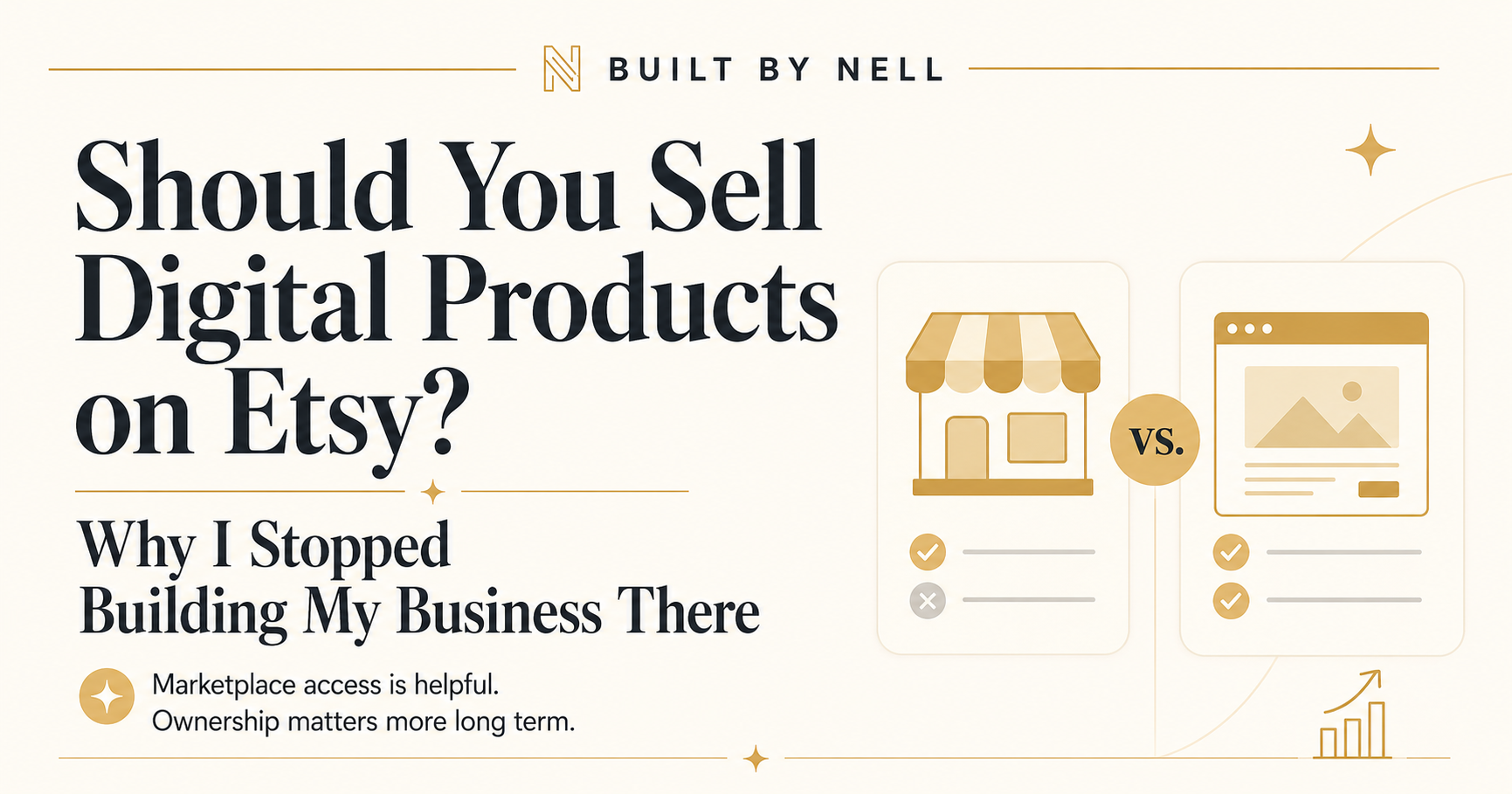
Should You Sell Digital Products on Etsy? Why I Stopped
Should you sell digital products on Etsy? My answer is not a dramatic yes or no. Etsy did not do anything dramatic to me. Nobody copied my products. My shop was not suspended. No customer horror story pushed me over the edge.
I stopped building my digital product business on Etsy for a much quieter reason: it was never fully mine to begin with.
My products are technically still listed there. I am not taking anything down in some big dramatic exit. I am just not renewing the listings or uploading anything new. My energy has moved somewhere else, and I want to walk you through exactly why, using my actual numbers instead of vague warnings.
Prefer to watch instead of read? I break down why I stopped building my digital product business on Etsy and what I am doing instead in the video below.
Why “Your Etsy Shop Isn’t Really Yours” Matters
You’ll hear people say “that Etsy shop is not yours” like it’s supposed to shock you. It shouldn’t. It’s just true, and once you sit with it, it explains a lot of the frustration Etsy sellers talk about.
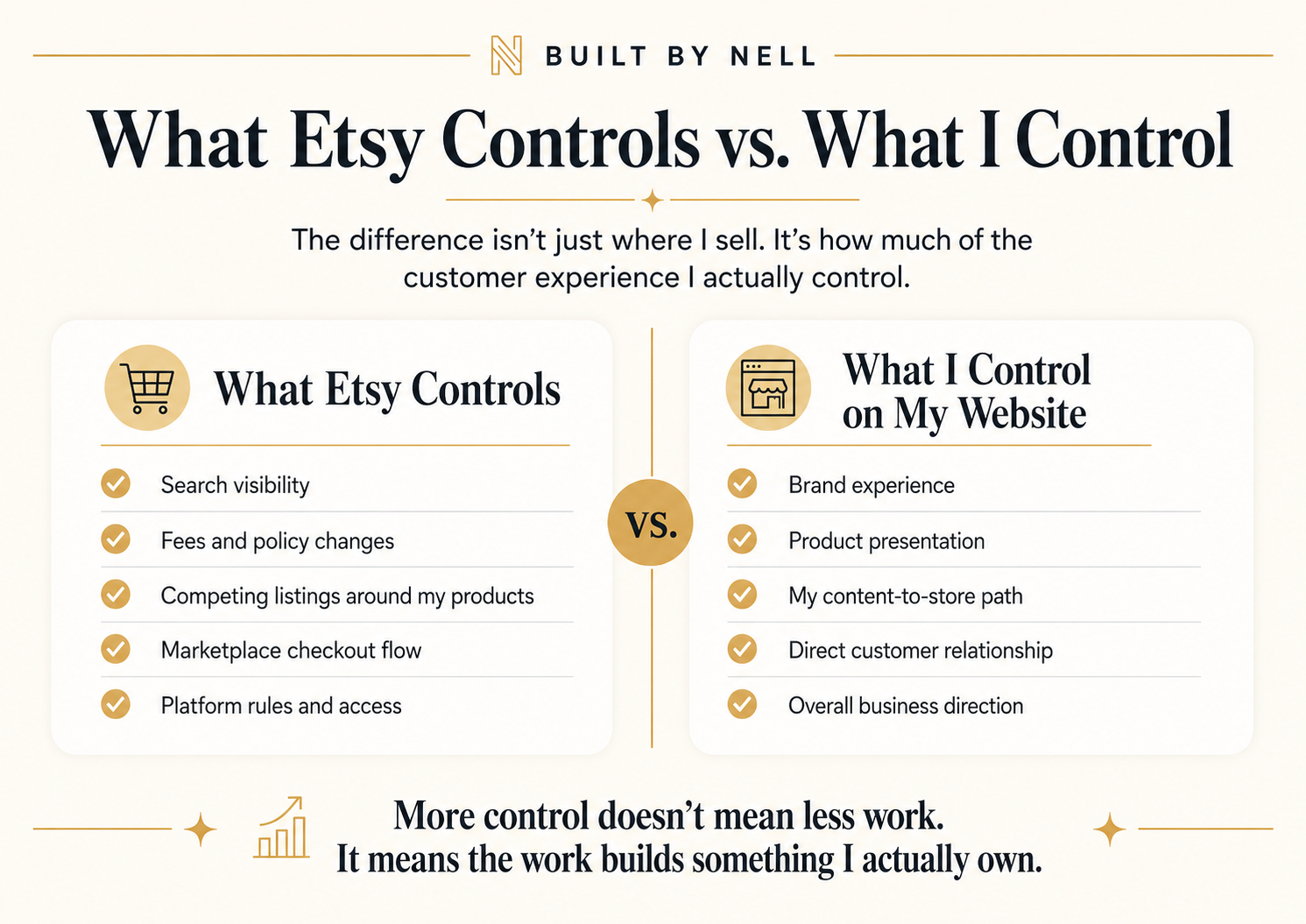
Etsy controls the platform. Etsy controls how customers discover your listings, what shows up next to your product on the page, what fees apply, and whether your shop stays visible or accessible at all. You are building inside someone else’s house, following someone else’s rules, and those rules can change without your input.
That is not an accusation. It is just how a marketplace works. The question is whether you are treating that marketplace as your whole business or as one channel inside a bigger one.
Marketplace Access vs. Business Ownership
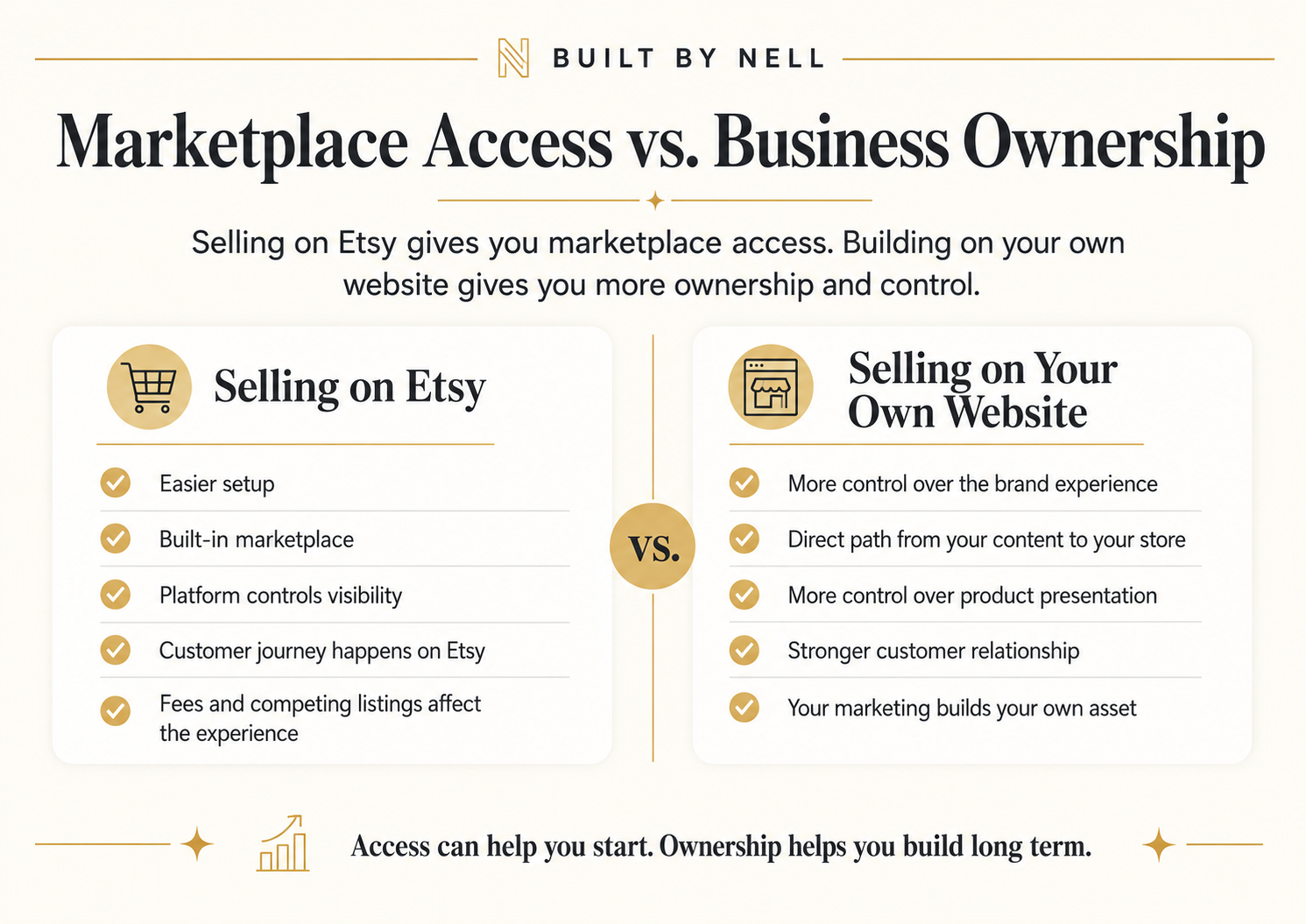
Here is the distinction I kept coming back to: access is not the same thing as ownership.
Etsy gives you access to a marketplace full of shoppers who are already in a buying mindset. That is genuinely valuable, especially early on. But access can be adjusted, deprioritized, or removed by the platform at any time, for reasons that have nothing to do with how good your product is.
Ownership looks different. When I sell through my own website, I have far more control over the customer experience, pricing, data, and direction of the business than I ever had on a marketplace I don’t own.
I was spending a lot of time trying to understand Etsy’s algorithm: what made a listing rank, what made search visibility shift, what triggered a dip in traffic. At some point, I realized I was optimizing for a system I would never fully control instead of building something that was actually mine.
What My Own Traffic Data Actually Showed
This is the part I think gets skipped in most “leave Etsy” content: the actual numbers.
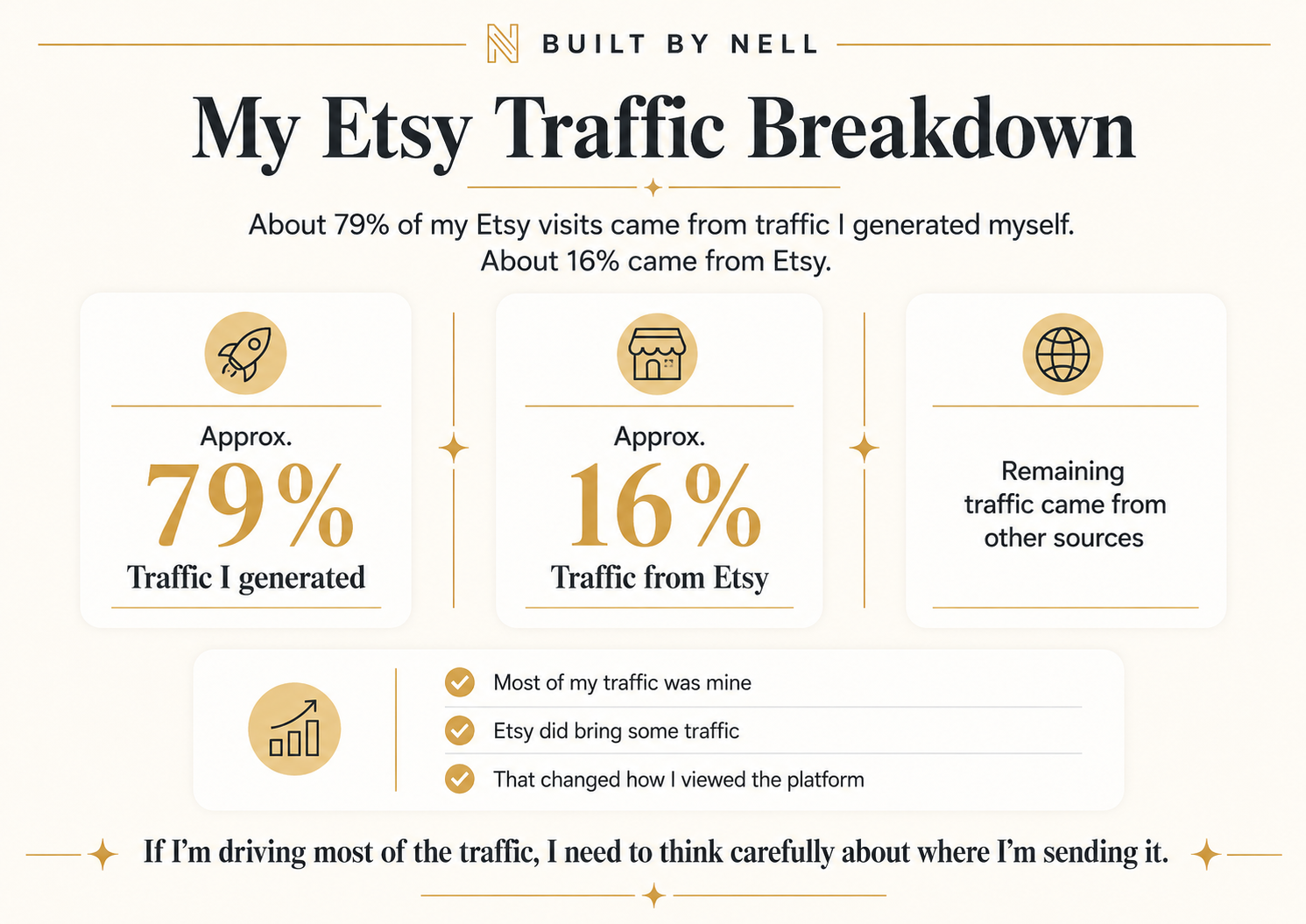
When I looked at where my Etsy shop’s traffic really came from, about 79% of my visits were traffic I brought myself. Only around 16% came from Etsy’s own search and marketplace traffic.
I want to be careful here, because it would be easy to twist that into “Etsy brought me nothing,” and that is not accurate. Etsy did bring some traffic. But the majority of the people finding my shop were people I had already worked to reach through my own content and marketing. I was doing most of the labor and still splitting the outcome with the platform.
That is the number that made me stop and ask: if I am the one generating most of this traffic anyway, why am I sending it to a storefront I don’t control instead of one I do?
The Fees and the Final Straw
Fees alone were not the reason I stopped. Fees plus what I was seeing on the actual customer journey is what finally tipped it.
What Etsy Actually Charges
According to Etsy’s own Fees & Payments Policy, sellers pay a $0.20 listing fee per item, a 6.5% transaction fee on the total sale price (including shipping), and a separate payment processing fee on top of that. None of those numbers are secret or unfair on their own. They are just costs that add up, especially when you are already the one driving most of your own traffic.
The final straw for me was the combination of those fees with what happens during the actual shopping experience. Etsy displays competing products around and within a customer’s browsing journey, sometimes directly on or near your own listing page. I was paying to bring a customer to my shop, then watching Etsy show that same customer other options before they even finished checking mine out.
Moving to My Own Site Didn’t Magically Fix Everything
If you are picturing me moving to my own website and suddenly having an easier business, I want to correct that right now.
Building my own website was hard. Genuinely, my honest word for the process was “terrible.” There was a learning curve, technical setup, and a lot of trial and error that Etsy had completely handled for me by comparison.
And moving platforms did not create customers out of nowhere. My own content and social media generated traffic to my website, just as they had been generating most of my Etsy traffic all along. Pinterest became part of that strategy over time. None of it was automatic. A website does not replace marketing. It just means the marketing I was already doing finally builds something I keep.
What WooCommerce Changed for Me
My website runs on WooCommerce. It does not charge an additional Etsy-style marketplace percentage on top of every sale, though standard payment processing and website costs still apply, so it is not free to run. What I noticed practically was that funds from website sales generally reached my account within days or the same week, which felt more predictable than waiting through Etsy’s payout schedule.
If a full custom build sounds like too much right now, that is a fair place to start smaller. Platforms like Squarespace or Hostinger offer simpler storefront setups for sellers who want more ownership without building everything from scratch. I am not ranking or recommending one over another here. I am just naming that the option exists if WooCommerce feels like too big a jump on day one.
What I Gained by Focusing on My Own Site
The biggest shift was not speed or traffic. It was control.
I decide what shows up next to my product. I decide what the checkout experience looks like. I have direct access to the customer data and the relationship after the sale, which means I can actually market to that person again instead of hoping they find my Etsy shop a second time. My website sales have started outpacing my Etsy sales, and that shift alone told me I was headed in the right direction.
When Etsy Still Makes Sense
I am not telling every digital product seller to abandon Etsy tomorrow. That would be irresponsible advice, and it is not what I believe.
Etsy can still be genuinely useful for discovery, for validating a new product idea, and for reaching shoppers who are already browsing there with intent to buy. For a lot of sellers, especially people just starting out, Etsy as one channel among several can work well.
The risk is not using Etsy. The risk is treating Etsy as the entire business, the only place your products, your customers, and your sales exist. My personal decision is to stop investing new energy into Etsy specifically and put that energy into my own website instead. That is my call for my business, not a universal rule.
Should You Sell Digital Products on Etsy? Questions to Ask Yourself
Should you sell digital products on Etsy, cut back, or leave entirely? Before you decide, sit with a few honest questions:
- Who is actually generating most of my traffic right now, me or the platform?
- Do I own the customer relationship after the sale, or does the platform?
- What happens to my business if this platform changes its policies or fees tomorrow?
- Am I building an asset I keep, or renting access I could lose?
- If my current audience wanted to buy from me today, could they find and purchase from me somewhere I actually control?
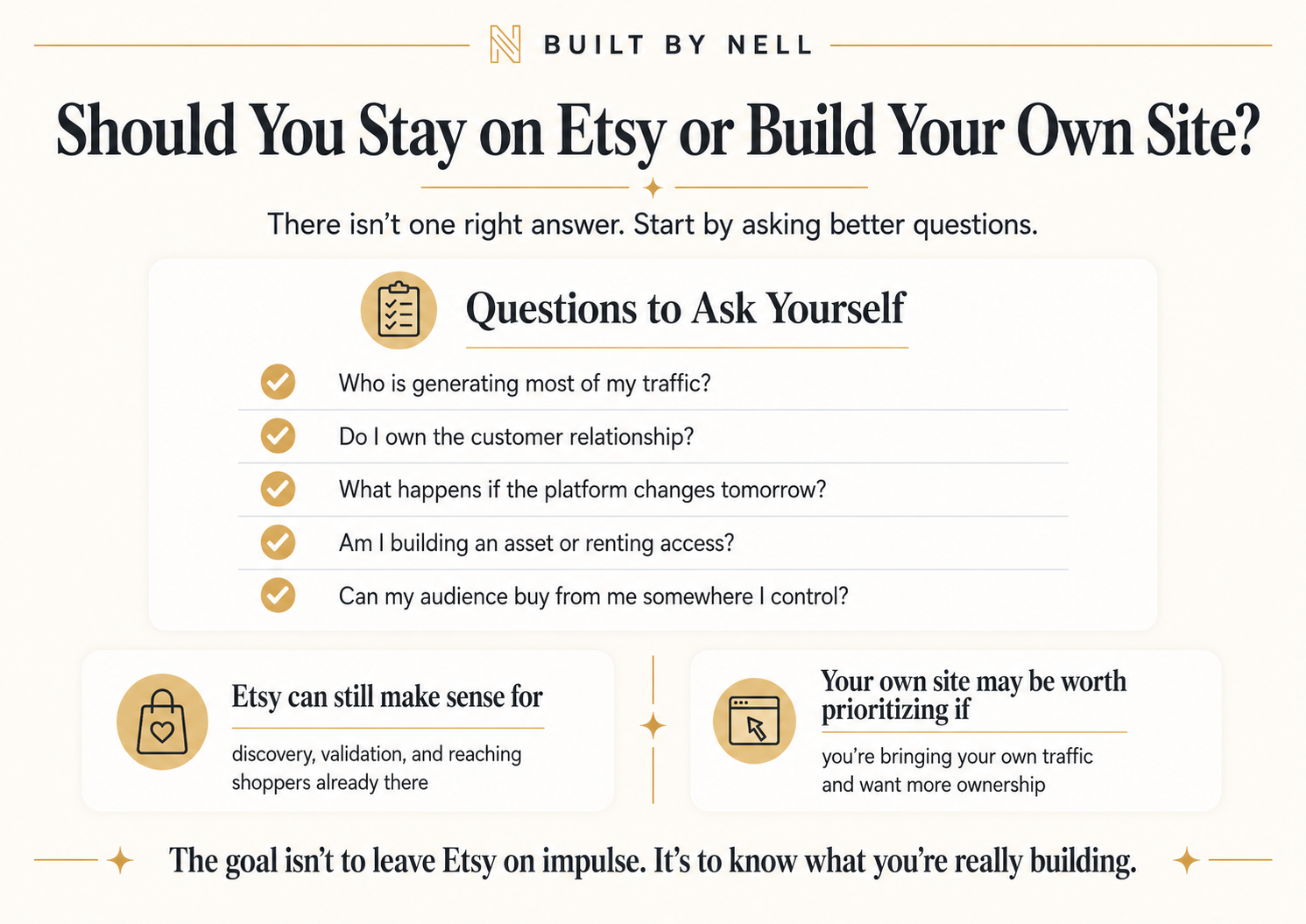
There is no single right answer here. The point is to actually ask the questions instead of drifting on autopilot.
What I’m Doing Next
I am not walking away from Etsy in some dramatic exit, and I am not pretending my own website is a finished, effortless system either. I am putting my energy into the platform I control, building my traffic and content strategy around it, and treating Etsy as something my existing listings sit on rather than something I actively grow anymore.
If you are a creator or small business owner sitting with the same question I was asking myself, the real starting point is not “Etsy or website.” It’s figuring out where you actually own your business right now, and where you’re just renting a shelf.
If you want to keep up with how I’m building this out, on my own website, with AI in the mix, and without pretending any of it is instant, take a look around Built By Nell, browse the shop, or subscribe for updates.
FAQ Section
Should you sell digital products on Etsy or your own website?
It depends on where most of your traffic is already coming from and whether you want to own the customer relationship long term. Etsy can work well for discovery and validation, especially early on. If you are already generating most of your own traffic through content or marketing, a platform you control may let you keep more of that value.
Why did you stop selling on Etsy?
The main reason was ownership, not a single bad incident. Etsy controls the platform, visibility, fees, and what shows up around my listings. Combined with what my own traffic data showed and the fee structure, I decided to focus my energy on my own website instead.
Does Etsy bring sellers traffic, or do sellers bring their own traffic?
It varies by shop, but in my case, roughly 79% of my Etsy visits came from traffic I brought myself, and around 16% came from Etsy’s own search and marketplace traffic. That mix is worth checking in your own Etsy Shop Manager stats before making a decision.
Is building your own website with WooCommerce expensive or hard to set up?
It was genuinely difficult for me, and I do not want to pretend otherwise. WooCommerce does not add an Etsy-style marketplace percentage on top of sales, but standard payment processing and website costs still apply. If a full custom build feels like too much right now, simpler storefront platforms exist as an easier starting point.
Should new sellers avoid Etsy completely?
No. Etsy can still be a useful channel for discovery and validating a new digital product, particularly for sellers just starting out. The risk isn’t using Etsy; it’s relying on it as the only place your business exists.