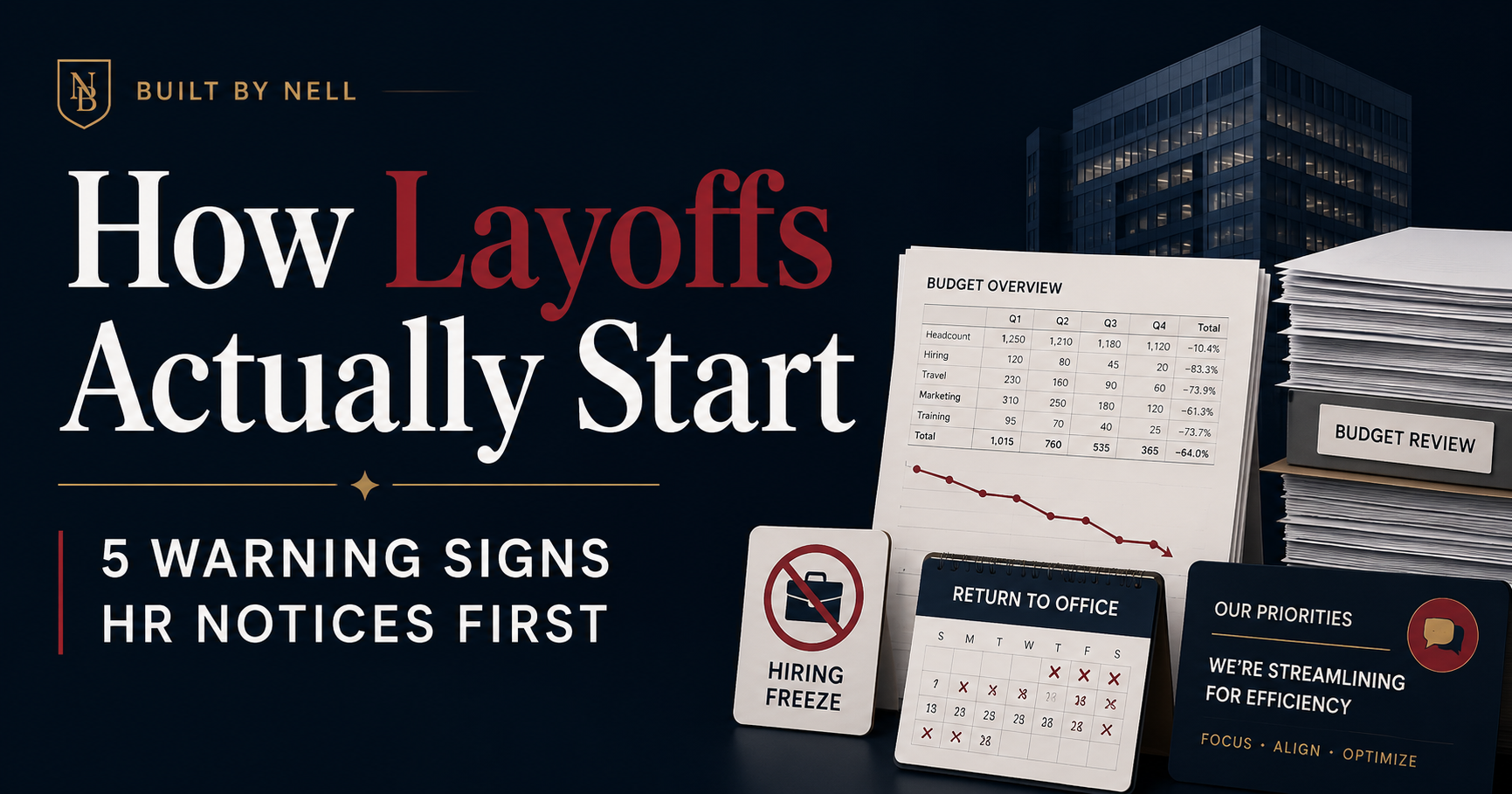
How Layoffs Actually Start: 5 Warning Signs Employees Miss
Are Layoffs Coming? Pay Attention Before the Announcement
Most people think layoffs start when the company sends the calendar invite, schedules the emergency meeting, or drops the dreaded “organizational changes” email.
But in many companies, layoffs start long before employees hear the word “layoff.”
They start with budget changes.
They start with spending restrictions.
They start with leadership suddenly caring about documentation.
They start with return-to-office pressure.
They start with corporate language that sounds harmless until you realize everyone is speaking in riddles.
Prefer to watch instead of read? I break this down in the full YouTube video below.
After more than 10 years working in Human Resources, I’ve seen how these patterns can show up before employees realize what is happening. And after being laid off myself, I also understand how different it feels when you are no longer looking at the situation from behind the HR curtain.
So let’s talk about the layoff warning signs employees often miss, what they may mean, and what you can do to protect yourself before someone else’s business decision becomes your emergency.
1. The Money Starts Changing
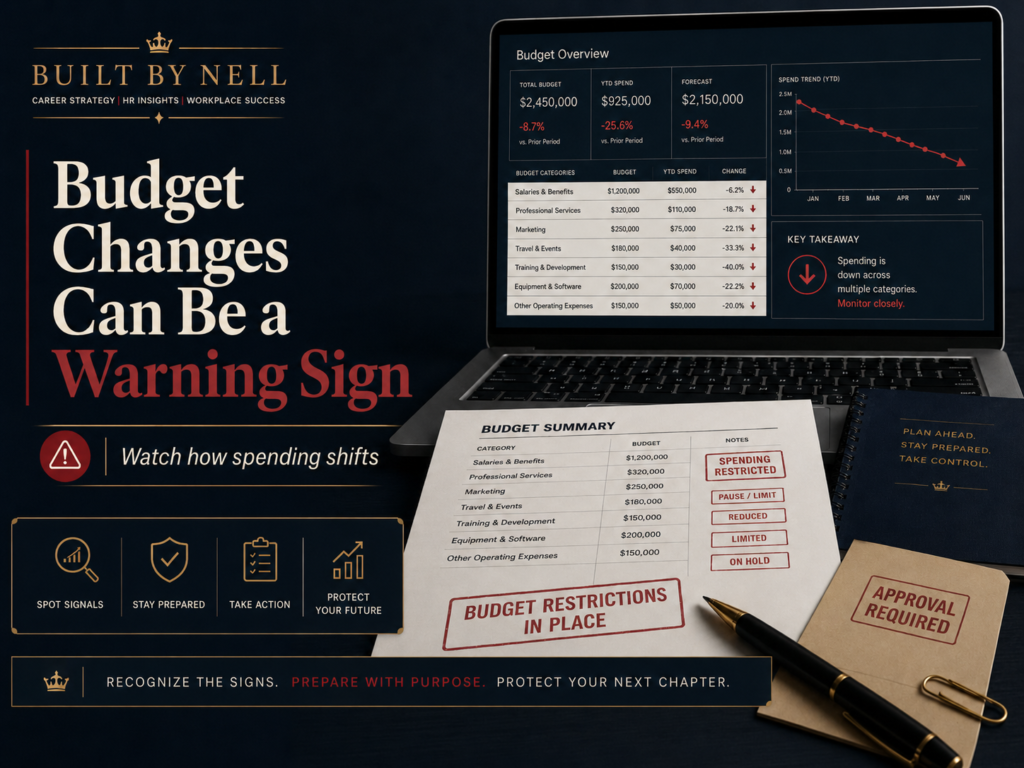
One of the first layoff warning signs employees may notice is that the money starts moving differently.
This does not always look dramatic at first. It can start small.
Maybe a department that usually gets what it needs suddenly has to justify every purchase. Maybe travel gets reduced. Maybe training budgets disappear. Maybe leadership starts asking managers to “hold off” on spending until the next quarter.
On its own, this does not automatically mean layoffs are coming.
Companies tighten budgets for many reasons.
But when the money starts changing across multiple departments at the same time, it is worth paying attention.
In HR, budget conversations matter because labor is usually one of the biggest expenses a company has. Before companies cut jobs, they often look for other ways to slow spending first.
That can include:
- Pausing new vendor contracts
- Cutting travel
- Delaying raises or bonuses
- Reducing training budgets
- Freezing non-essential purchases
- Asking leaders to reforecast department expenses
The important thing is not to panic every time someone says the word “budget.”
The important thing is to notice patterns.
If your company was freely spending six months ago and now every dollar needs a permission slip, that is information.
And information helps you move smarter.
2. Spending Suddenly Gets Restricted
The second sign is closely connected to the first, but it deserves its own section because it directly affects employees.
Spending restrictions can show up in very specific ways.
Suddenly, you may hear things like:
- “We need approval before moving forward.”
- “Let’s revisit this next quarter.”
- “That is not in the budget right now.”
- “We are being more mindful of spending.”
- “We need to reduce unnecessary expenses.”
Again, one delayed purchase does not mean the sky is falling.
But when the entire company starts acting like ordering printer paper requires a congressional hearing, that is when my HR ears perk up.
Spending restrictions can be an early sign that leadership is trying to preserve cash, reduce operating costs, or slow down financial bleeding before making bigger workforce decisions.
This is especially important if the restrictions affect people-related expenses.
For example:
- Backfills are paused when employees leave
- Open roles are suddenly put on hold
- Contractors are reduced
- Overtime is limited
- Training is canceled
- Team events disappear
- New software approvals stop
That is when the pattern becomes more serious.
When a company stops investing in people, roles, tools, and growth, employees should at least start asking themselves:
“Is this temporary tightening, or is something bigger happening?”
You may not get a direct answer.
But your job is not to wait until leadership confirms what you already feel shifting.
Your job is to prepare.
3. Documentation Becomes a Priority
This is one of the biggest signs employees overlook.
Documentation.
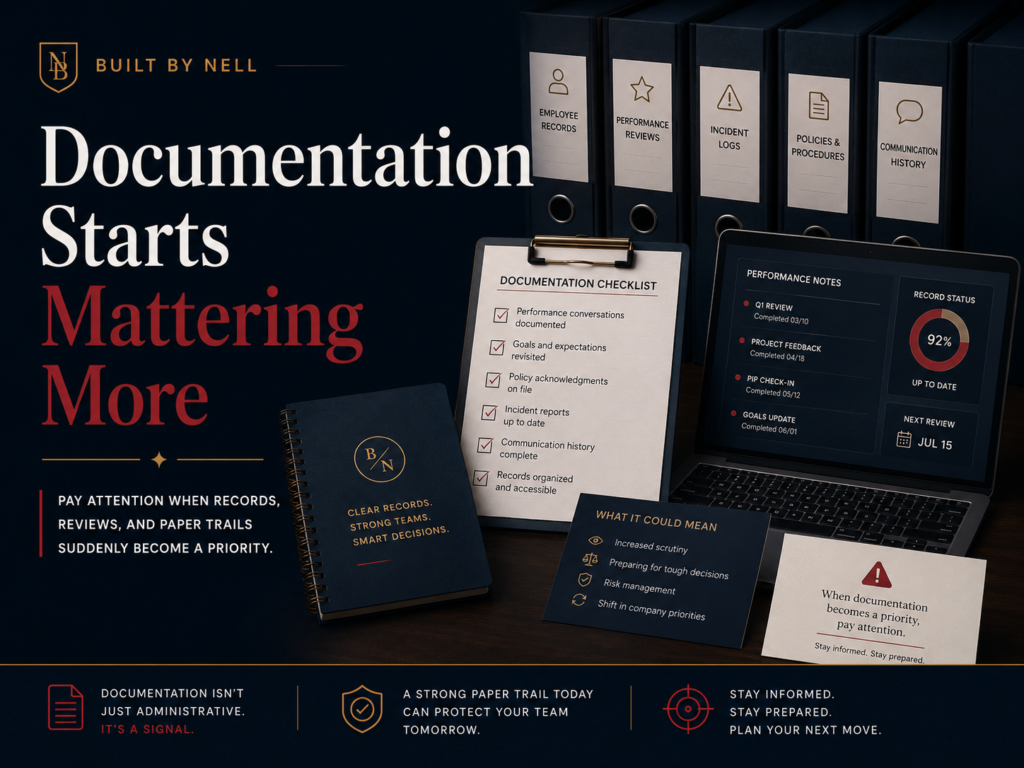
Now, let me be clear. Documentation is a normal part of HR and management. Good companies should document performance, expectations, conversations, coaching, policy issues, and business decisions.
But when documentation suddenly becomes a major focus, especially after being ignored for months or years, pay attention.
If managers who rarely documented anything are suddenly being asked to update performance notes, clean up files, review job descriptions, or track employee issues more closely, it may mean leadership is preparing to make decisions that require a paper trail.
That does not always mean layoffs.
Sometimes it means performance management.
Sometimes it means compliance cleanup.
Sometimes it means a leadership change.
But sometimes, it means the company wants its records in order before making workforce changes.
Employees often miss this because documentation happens behind the scenes.
You may not see the meeting where leadership asks managers to update files.
You may not see HR reminding managers to document performance issues.
You may not see the sudden urgency around employee records, org charts, or role responsibilities.
But you may feel the shift.
Maybe your manager suddenly becomes more formal.
Maybe conversations that used to be casual are now followed up by email.
Maybe expectations are being restated in writing.
Maybe performance feedback becomes more specific.
Maybe your manager is suddenly asking for status updates on everything.
That does not mean you should spiral.
But it does mean you should start documenting too.
Because if the company is creating records, you should also have your own.
Start tracking:
- Your accomplishments
- Projects you completed
- Metrics you improved
- Positive feedback
- Important emails
- Responsibilities outside your job description
- Any changes to your workload or reporting structure
Documentation protects companies.
But documentation can also protect you.
Do not let the company be the only one with receipts.
4. Return-to-Office Pressure Increases
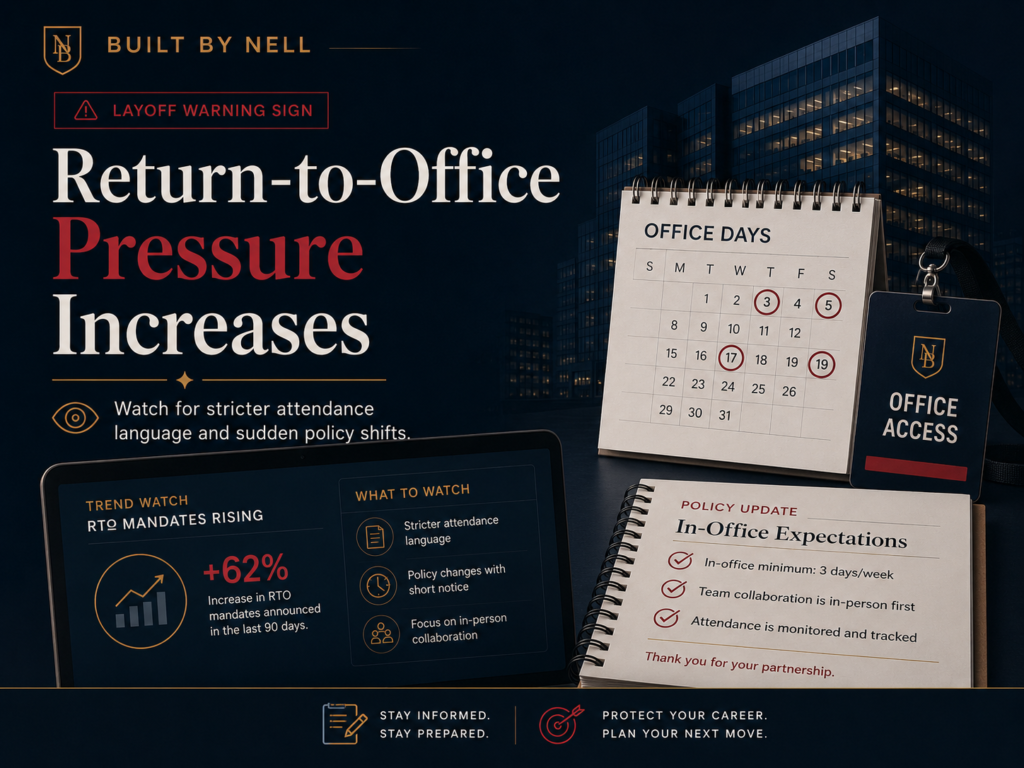
Return-to-office policies can be driven by culture, collaboration, real estate, leadership preferences, or operational needs.
But in some cases, return-to-office pressure can also be connected to a workforce reduction strategy.
Not always.
But sometimes.
Here is why employees should pay attention.
When companies become more strict about return-to-office requirements, some employees may leave on their own. That reduces headcount without the company having to conduct formal layoffs.
That does not mean every RTO policy is a layoff strategy.
But if return-to-office suddenly becomes stricter during a time when the company is also cutting budgets, freezing hiring, reducing expenses, and changing leadership language, it may be part of a bigger pattern.
The key is the timing.
Ask yourself:
- Did the company suddenly become strict after months of flexibility?
- Are exceptions harder to get?
- Are leaders saying things like “accountability,” “productivity,” or “alignment” more often?
- Are employees who push back being treated differently?
- Is the policy being enforced unevenly?
- Are people leaving and not being replaced?
If the return-to-office push is happening alongside other warning signs, it is worth paying attention.
You do not have to assume the worst.
But you also do not have to ignore what is happening right in front of you.
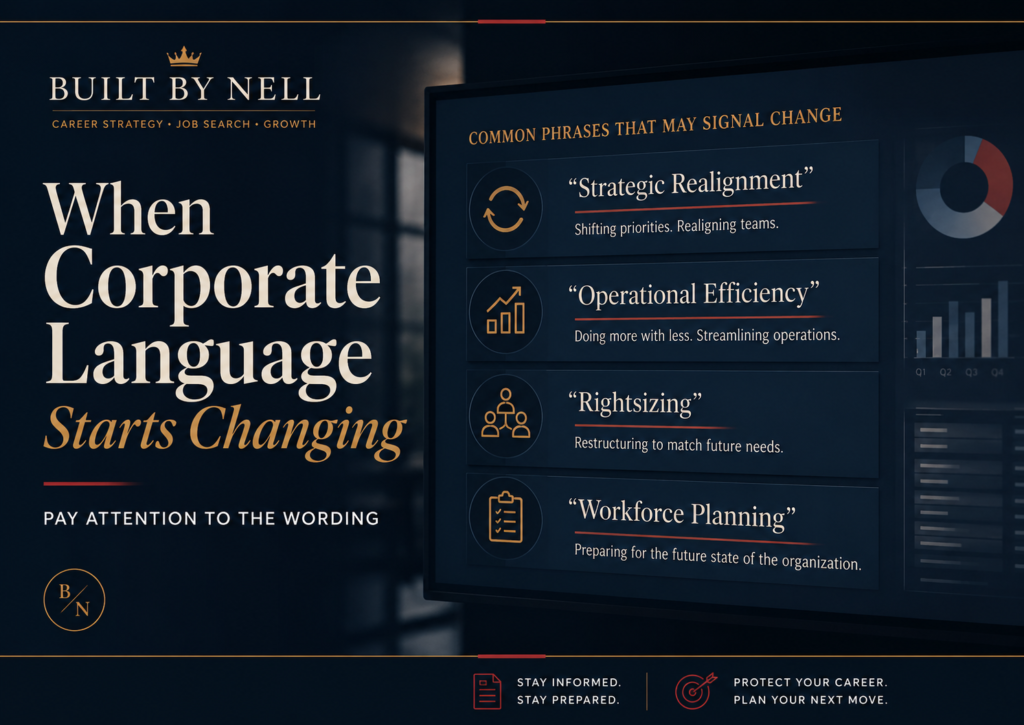
5. Corporate Language Starts Changing
This is one of my biggest HR insider tells.
Corporate language changes before corporate actions happen.
When a company is preparing for major changes, leadership often starts using vague, polished language that sounds professional but says almost nothing directly.
You may hear phrases like:
- Operational efficiency
- Cost optimization
- Strategic realignment
- Organizational restructuring
- Workforce planning
- Role clarity
- Business needs
- Evolving priorities
- Rightsizing
- Streamlining
- Doing more with less
Individually, these phrases do not always mean layoffs.
But when they start showing up repeatedly in town halls, emails, leadership meetings, and company updates, pay attention.
Corporate language is often designed to soften the blow before the blow arrives.
That is why employees need to listen beyond the words.
Do not just ask:
“What did they say?”
Ask:
“What did they avoid saying?”
Because sometimes the most important part of a company update is what leadership refuses to answer directly.
If employees ask direct questions about hiring, budget, team stability, or the company’s future, and leadership keeps responding with vague language, that may be a sign that decisions are already being discussed behind closed doors.
Not confirmed.
Not guaranteed.
But discussed.
And if you are hearing corporate word salad every week, it may be time to get your house in order.
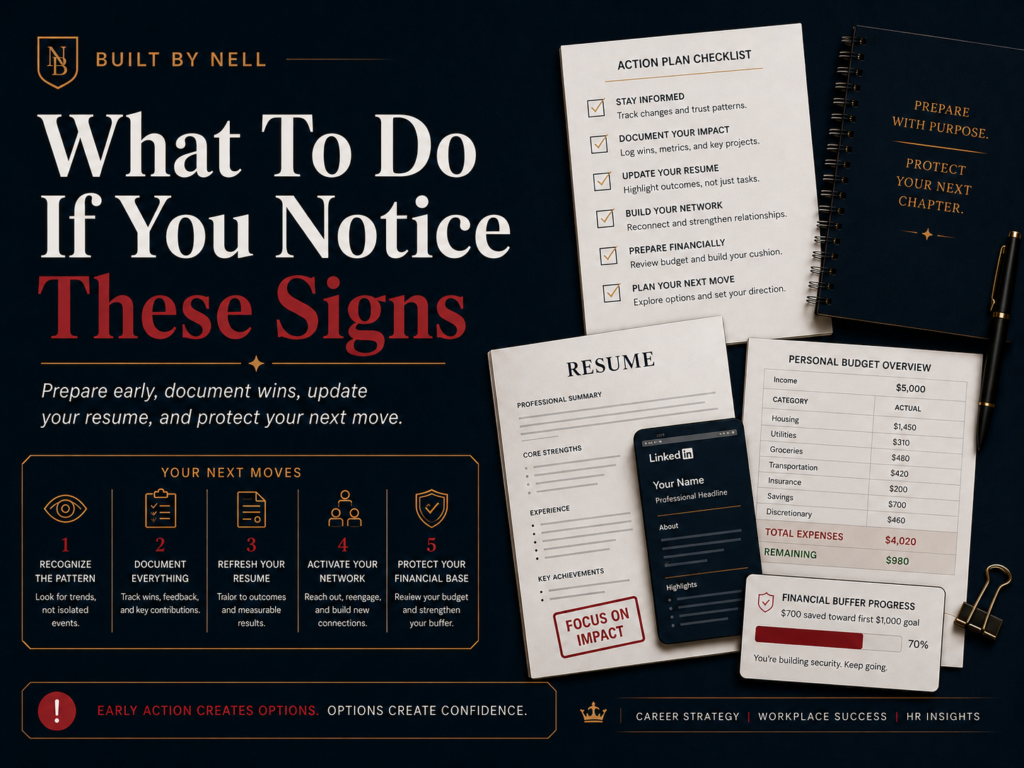
What To Do If You Notice Layoff Warning Signs
Seeing one warning sign does not mean you are getting laid off.
Seeing two warning signs does not mean you need to pack up your desk.
But if multiple signs start happening at the same time, you should stop waiting for someone else to tell you to prepare.
Preparation does not mean panic.
Preparation means options.
Here is what I would do.
Update Your Resume
Do not wait until you are emotional, shocked, or scrambling.
Update your resume while you still have access to your work accomplishments, metrics, projects, and results.
Focus on:
- Revenue saved or generated
- Processes improved
- Teams supported
- Systems implemented
- Problems solved
- Compliance issues handled
- Leadership impact
- Measurable outcomes
Your resume should not read like a job description.
It should read like proof.
Refresh Your LinkedIn Profile
If layoffs happen, many people will update their LinkedIn profiles at the same time.
Get ahead of that.
Update your headline, about section, featured links, experience, and skills before you need attention.
And no, you do not have to announce that you are looking.
You can quietly strengthen your profile.
Document Your Work
Keep a private record of your accomplishments.
Not on your work computer.
Not in your work email only.
Somewhere you can access if your company cuts off your accounts.
Track wins, feedback, projects, numbers, and anything that helps you explain your value.
Review Your Money
This is the part people avoid, but it matters.
If your income stopped tomorrow, how long could you cover your bills?
What could you cut immediately?
What subscriptions need to go?
What bills could you negotiate?
What benefits would you need to understand?
You can also review the U.S. Department of Labor’s WARN Act guidance to understand when certain employers may be required to provide advance notice before covered plant closings or mass layoffs.
This is why I created the Laid Off Money Survival Kit. Because when a layoff happens, people are not just dealing with career stress. They are dealing with rent, food, bills, benefits, debt, and fear.
The more you understand your numbers before a crisis, the less power panic has over you.
Need help figuring out your layoff money plan? Get the Laid Off Money Survival Kit.
Start Networking Before You Need Help
The worst time to build a network is when you desperately need one.
Start now.
Reconnect with old coworkers.
Comment on industry posts.
Message people you respect.
Let trusted contacts know what kind of roles you are interested in.
You do not need to beg.
You just need to be visible.
Pay Attention Without Spiraling
This is the balance.
You do not want to ignore the signs.
But you also do not want to spend every workday doom-scrolling your own career.
Pay attention.
Prepare quietly.
Keep doing good work.
And build options.
That is the strategy.
Final Thoughts
Layoffs can feel personal, but most of the time they are business decisions.
That does not make them painless.
That does not make them fair.
That does not mean people are wrong for being upset, angry, scared, or disappointed.
But the more you understand how layoffs actually start, the more prepared you can be before the announcement happens.
The goal is not to live in fear.
The goal is to stop being caught completely off guard.
Because when you know what to look for, you can move differently.
And in this job market, moving differently matters.
Related Resources
Free Career Blueprint:
The Blueprint: 5 Corporate Truths They Don’t Teach You Until You Learn Them the Hard Way
https://builtbynell.com/free-career-resources/
Laid Off Money Survival Kit:
Guide, spreadsheet, and scripts for life after layoff
https://builtbynell.com/product/the-laid-off-money-survival-kit-for-life-after-layoff/